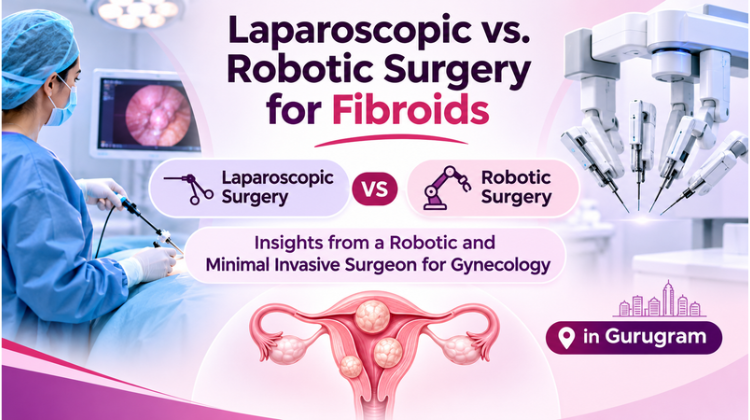
Laparoscopic vs. Robotic Surgery for Fibroids: Insights from a Robotic and Minimal Invasive Surgeon for gynecology in Gurugram
Uterine fibroids remain among the most common non-cancerous growths affecting women of reproductive age. These benign tumors, originating in the muscular wall of the uterus, can cause heavy menstrual bleeding, severe pelvic pain, frequent urination, pressure symptoms, and fertility complications. Historically, removing large or complex fibroids meant undergoing open abdominal surgery (laparotomy), which involved large incisions, significant blood loss, high infection risks, and weeks of painful recovery.
Modern gynecological care has transformed this experience. Advanced surgical innovation allows women to undergo complex surgical procedures with minimal discomfort, negligible scarring, and rapid recovery times. When evaluating options to preserve the uterus and remove fibroids (myomectomy) or perform a definitive hysterectomy, consulting a certified Robotic and Minimal Invasive Surgeon for gynecology in Gurugram ensures access to high-precision care tailored to your anatomical requirements.
This detailed guide compares traditional laparoscopic techniques with next-generation robotic-assisted surgery for uterine fibroids, helping you make informed decisions for your reproductive and long-term health.
                       +------------------------------------------------+
                       |           FIBROID SURGICAL SPECTRUM            |
                       +------------------------------------------------+
                                               |
                  +----------------------------+----------------------------+
                  |                                                         |
                  v                                                         v
    +---------------------------+                             +---------------------------+
    |   LAPAROSCOPIC APPROACH   |                             |     ROBOTIC APPROACH      |
    +---------------------------+                             +---------------------------+
    | - 2D High-Definition View |                             | - 3D High-Definition View |
    | - Straight, Rigid Tools   |                             | - Wristed EndoWrist (7 DOF|
    | - Manual Suturing         |                             | - Ergonomic Console       |
    | - Ideal for Standard      |                             | - Tremor Filtering        |
    |   Fibroid Cases           |                             | - Ideal for Deep, Large,  |
    |                           |                             |   or Multiple Fibroids    |
    +---------------------------+                             +---------------------------+
                  |                                                         |
                  +----------------------------+----------------------------+
                                               |
                                               v
                               +--------------------------------+
                               |     SUPERIOR OUTCOMES          |
                               | - Minimal Blood Loss           |
                               | - Tiny 8mm Incisions           |
                               | - 24-48 Hr Hospital Discharge   |
                               | - Uterine Structure Preserved  |
                               +--------------------------------+
1. Understanding Uterine Fibroids and Minimal Access Options
Uterine fibroids (leiomyomas) vary dramatically in size, quantity, and position. They are generally categorized based on location:
-
Subserosal Fibroids: Project outward from the outer uterine wall into the pelvic cavity.
-
Intramural Fibroids: Embedded deep within the muscular uterine wall, often altering uterine structure.
-
Submucosal Fibroids: Extend inward toward the endometrial cavity, causing heavy menstrual bleeding and fertility issues.
When medications fail to relieve fibroid symptoms, surgical interventions become necessary. Selecting an experienced Robotic and Minimal Invasive Surgeon for gynecology in Gurugram allows patients to explore state-of-the-art organ-preserving interventions rather than defaulting to open abdominal surgery.
                  +-----------------------------------+
                  |   TYPES OF UTERINE FIBROIDS       |
                  +-----------------------------------+
                                    |
          +-------------------------+-------------------------+
          |                         |                         |
          v                         v                         v
+-------------------+     +-------------------+     +-------------------+
|    SUBSEROSAL     |     |    INTRAMURAL     |     |    SUBMUCOSAL     |
| (Grows outward    |     | (Deep inside muscle|     | (Pushes into      |
| into pelvis)      |     | wall of uterus)   |     | endometrial space)|
+-------------------+     +-------------------+     +-------------------+
2. Laparoscopic Myomectomy: The Benchmark in Minimal Access
Laparoscopic surgery revolutionized pelvic operations by eliminating long abdominal incisions. In a conventional laparoscopic myomectomy, the surgical team inserts a thin camera (laparoscope) and long, rigid operating tools through 3 to 4 tiny incisions (ranging from 5mm to 12mm) in the lower abdomen.
How Laparoscopic Fibroid Removal Works
-
Pneumoperitoneum: The abdominal cavity is gently inflated with medical-grade carbon dioxide gas to create clear visual space.
-
Visualization: High-definition cameras project two-dimensional images onto surgical monitors in the operating theater.
-
Excision & Morcellation: The surgeon cuts into the uterine muscle layer, shells out the fibroid capsule, and uses a contained tissue extractor (morcellator) to remove the tissue safely through tiny port holes.
-
Reconstruction: The incision in the uterine wall is sutured in layers to ensure structural strength.
Key Benefits of Laparoscopy
-
Small Incisions: Significantly reduced postoperative scarring compared to open surgery.
-
Low Infection Rates: Closed surgical environments reduce exposure to airborne hospital pathogens.
-
Shorter Hospitalization: Most patients go home within 24 to 48 hours.
Technical Limitations of Laparoscopy
While laparoscopy offers major advantages over open surgery, it has mechanical limitations when handling complex fibroids. Standard laparoscopic instruments are straight and rigid, offering limited movement inside restricted pelvic quarters. Furthermore, manual suturing of deep intramural defects in 2D views can be challenging, requiring high expertise from an experienced Robotic and Minimal Invasive Surgeon for gynecology in Gurugram.
3. Robotic-Assisted Surgery: The Next Generation of Surgical Precision
Robotic-assisted surgery (utilizing platform systems like the da Vinci Xi) addresses the technical constraints of conventional laparoscopy. The robotic system does not perform the operation autonomously; it acts as an advanced extension of the surgeon’s hands, translating real-time wrist movements into ultra-precise micro-motions inside the patient’s body.
       +-------------------------------------------------------+
       |       ROBOTIC SURGICAL SYSTEM ARCHITECTURE            |
       +-------------------------------------------------------+
                                   |
           +-----------------------+-----------------------+
           |                                               |
           v                                               v
+-----------------------+                       +-----------------------+
|   SURGEON CONSOLE     |                       |   PATIENT-SIDE CART   |
| - 3D HD True Depth    |                       | - Robotic Arms        |
| - Ergonomic Controls  |                       | - EndoWrist System    |
| - Tremor Filtering    |                       | - 8mm Keyhole Ports   |
+-----------------------+                       +-----------------------+
           |                                               |
           +-----------------------+-----------------------+
                                   |
                                   v
                       +-----------------------+
                       | HIGH-PRECISION TISSUE |
                       | EXCISION & MULTI-LAYER|
                       | UTERINE SUTURING      |
                       +-----------------------+
Key Technical Innovations in Robotic Surgery
-
3D High-Definition Visualization: Surgeons view anatomical structures in magnified, true-depth 3D HD, allowing precise differentiation between healthy uterine tissue and fibroid margins.
-
EndoWrist Technology: Robotic instruments rotate 540 degrees with seven degrees of freedom, mimicking and expanding upon the natural flexibility of the human hand and wrist.
-
Motion Scaling and Tremor Filtering: Computerized filtering eliminates subtle hand tremors, making delicate dissections safer near vital pelvic structures like the ureters, bladder, and major blood vessels.
-
Ergonomic Control: Operating from an ergonomic console reduces surgeon physical fatigue during lengthy, complex reconstructions.
Consulting a specialized Robotic and Minimal Invasive Surgeon for gynecology in Gurugram ensures access to these technological capabilities when managing large, deep, or multiple uterine fibroids.
4. Head-to-Head Comparison: Laparoscopic vs. Robotic Surgery for Fibroids
Evaluating treatment options with a Robotic and Minimal Invasive Surgeon for gynecology in Gurugram involves reviewing how each surgical method handles key clinical factors.
| Clinical Feature | Conventional Laparoscopic Surgery | Robotic-Assisted Surgery |
| Camera Vision | 2D Flat Screen Display | 3D High-Definition Magnified View |
| Instrument Maneuverability | Rigid, straight tools (Limited range) | Articulated EndoWrist (540° Rotation) |
| Suturing Capability | Manual straight-line suturing | High-precision multi-layer suturing |
| Complex / Deep Intramural Fibroids | Technically demanding | Exceptionally suited for deep access |
| Tremor Control | Direct manual control | Automated computerized tremor removal |
| Incision Size | 3 to 4 tiny ports (5–12mm) | 3 to 4 tiny ports (8mm) |
| Blood Loss Risk | Low | Minimal (Enhanced vessel sealing) |
| Post-Operative Recovery | 1 to 2 weeks | 1 to 2 weeks |
5. Surgical Indications: Which Method Is Right for You?
Not every patient requires robotic surgery, just as not every fibroid case should be managed with basic laparoscopy. An evaluation with a Robotic and Minimal Invasive Surgeon for gynecology in Gurugram helps determine the optimal approach based on specific clinical parameters.
                 +-----------------------------------+
                 |    SURGICAL SELECTION FLOWCHART   |
                 +-----------------------------------+
                                   |
         +-------------------------+-------------------------+
         |                                                   |
         v                                                   v
+----------------------------------+   +----------------------------------+
| STANDARD LAPAROSCOPY INDICATIONS |   | ROBOTIC SURGERY INDICATIONS      |
| - 1 to 3 Small/Medium Fibroids   |   | - Multiple or Large (>7-8cm)     |
| - Subserosal or Superficial      |   | - Deep Intramural Locations      |
| - Routine Anatomical Access      |   | - Prior Pelvic Operations        |
| - Basic Reconstructive Needs     |   | - Severe Endometriosis / Adhesions|
|                                  |   | - High Priority on Fertility     |
+----------------------------------+   +----------------------------------+
When Conventional Laparoscopy Works Well
Laparoscopic myomectomy is often effective for:
-
Single or low-count fibroids (1 to 3 nodules).
-
Subserosal fibroids located on the outer uterine surface.
-
Small to moderate fibroid diameters (under 6–7 cm).
-
Patients without significant prior abdominal surgeries or dense pelvic scar tissue.
When Robotic-Assisted Surgery Is Preferred
A Robotic and Minimal Invasive Surgeon for gynecology in Gurugram will often recommend robotic assistance for:
-
Multiple or Large Fibroids: Multiple fibroids embedded across different uterine zones or individual fibroids exceeding 7–8 cm.
-
Deep Intramural and Broad Ligament Locations: Fibroids positioned near vital uterine blood supply lines, the cervix, or the broad ligament.
-
Fertility Preservation & Future Pregnancy: Patients planning future pregnancies require multi-layer uterine wall reconstruction to ensure the uterus can safely stretch during gestation without rupture risks.
-
Complex Pelvic Conditions: Co-existing conditions such as severe pelvic endometriosis, frozen pelvis, or extensive scar tissue from prior surgical operations.
6. Patient Recovery, Safety Protocols, and Long-Term Outcomes
Both laparoscopic and robotic options provide major recovery advantages over open abdominal operations. Patients treated by a Robotic and Minimal Invasive Surgeon for gynecology in Gurugram benefit from standardized surgical pathways designed for safety and quick recovery.
Immediate Post-Operative Phase (First 24–48 Hours)
-
Early Ambulation: Patients are encouraged to stand and walk within hours of surgery to promote blood circulation and prevent deep vein thrombosis (DVT).
-
Minimal Pain Management: Micro-incisions require lower doses of post-operative pain medications compared to traditional open incisions.
-
Early Diet Resumption: Normal clear fluids and soft diets are typically resumed on the same day as surgery.
Short-Term Recovery (Weeks 1 to 2)
-
Most patients return to light household activities and sedentary work within 7 to 10 days.
-
Driving can typically be resumed after one week, provided the patient is off opioid pain medications and moving comfortably.
Long-Term Outcomes & Uterine Integrity
Proper suturing of the uterine defect is essential for long-term health. Precise multi-layer suturing performed by a Robotic and Minimal Invasive Surgeon for gynecology in Gurugram ensures the uterine muscle (myometrium) heals with minimal scarring, preserving structural integrity for future pregnancies.
Master Clinical Summary: Comparing Surgical Approaches
Review this overview when discussing fibroid treatment options with a Robotic and Minimal Invasive Surgeon for gynecology in Gurugram:
| Clinical Consideration | Traditional Open Surgery (Laparotomy) | Conventional Laparoscopy | Advanced Robotic Surgery |
| Abdominal Incision | 10–15 cm single horizontal/vertical cut | 3–4 small keyholes (5–12mm) | 3–4 small keyholes (8mm) |
| Hospital Stay | 3 to 5 days | 1 to 2 days | 1 to 2 days |
| Full Recovery Time | 6 to 8 weeks | 1 to 2 weeks | 1 to 2 weeks |
| Suturing Precision | High | Moderate (Restricted tools) | Ultra-High (Wristed 3D control) |
| Blood Loss | Moderate to High | Low | Minimal |
| Cosmetic Result | Prominent scarring | Minimal, tiny marks | Minimal, tiny marks |
#Robotic and Minimal Invasive Surgeon for gynecology in Gurugram #Best Gynecologist in Gurgaon #Dr Preeti Rastogi #Medanta The Medicity Gurgaon #Robotic Fibroid Surgery Gurgaon #Laparoscopic Myomectomy Gurgaon #Minimal Access Gynecologic Surgery #Gynecologist in Gurugram #Robotic Hysterectomy Gurgaon #High Risk Obstetrics Gurgaon #Da Vinci Xi Robotic Surgeon #Fibroid Treatment Gurgaon #Uterine Fibroid Removal #Fertility Preserving Surgery #Endometriosis Treatment Gurgaon #Advanced Gynecology Gurugram #Best Obstetrician in Gurgaon #MRCOC Gynaecologist Gurgaon #Laparoscopic Gynecologist Gurgaon #Urogynecology Gurgaon #Pelvic Organ Prolapse Treatment #Safe Motherhood Practices #Normal Vaginal Delivery Doctor #Maternal Fetal Medicine Gurgaon #Gynecologic Surgeon Gurugram #Women Health Specialist Gurgaon #Minimally Invasive Myomectomy #Robotic Surgery In Gynecology #Gurgaon Gynecology Clinic #3D Robotic Surgery Gurgaon #Complex Gynaecological Surgery
FAQ
Question 1: What sets Dr. Preeti Rastogi apart as a leading Minimal Invasive and Robotic Gynecologist in Gurugram?
Answer:
Dr. Preeti Rastogi is an acclaimed Obstetrician and Gynecologist serving as Director and Head of Department of Obstetrics and Gynecology at Medanta – The Medicity, Gurgaon. Her clinical practice is distinguished by:
-
Over 25 Years of International Experience: Extensive practice in prestigious tertiary healthcare institutions across the United Kingdom (including the University Hospital of Wales, Cardiff, and Singleton Hospital, Swansea) and top medical centers in India.
-
Advanced International Certifications: Qualified with an MBBS, DNB (Obstetrics & Gynecology), and MRCOG from the Royal College of Obstetricians and Gynaecologists (RCOG), London, UK.
-
Certified Da Vinci Xi Robotic Surgeon: Credentialed expert in advanced robotic-assisted laparoscopic surgery, minimal access fibroid removal, total laparoscopic hysterectomy, complex endometriosis excision, and pelvic floor reconstruction.
-
High-Risk Obstetrics & Safe Motherhood Advocate: Dedicated specialist in maternal-fetal medicine, high-risk pregnancy management, and safe delivery practices. Laparoscopic vs. Robotic Surgery for Fibroids: Insights from a Robotic and Minimal Invasive Surgeon for gynecology in Gurugram
About Dr. Preeti Rastogi:
-
Current Leadership Position: Director & HOD, Department of Obstetrics and Gynecology at Medanta – The Medicity, Gurugram.
-
Medical Qualifications: MBBS (G.R. Medical College, Gwalior), DNB in Obstetrics & Gynecology (St. Stephen’s Hospital, Delhi), and MRCOG (Royal College of Obstetricians and Gynaecologists, London, UK).
-
Surgical Certification: Officially certified Da Vinci Xi Robotic Surgeon specializing in advanced minimally invasive pelvic operations.
-
International Practice History: Spent over a decade practicing as a specialist consultant within the National Health Service (NHS) in Wales, UK (including University Hospital of Wales and Singleton Hospital).
-
Professional Memberships: Active member of the Royal College of Obstetricians and Gynaecologists (RCOG, UK), American College of Obstetricians and Gynecologists (ACOG), and British Society of Urogynaecology. Laparoscopic vs. Robotic Surgery for Fibroids: Insights from a Robotic and Minimal Invasive Surgeon for gynecology in Gurugram
Question 2: How does a Robotic and Minimal Invasive Surgeon for gynecology in Gurugram manage high-risk obstetrics alongside complex fibroid surgeries?
Answer:
Managing complex reproductive conditions alongside pregnancy requires integrated maternal-fetal and minimal access surgical expertise. An experienced Robotic and Minimal Invasive Surgeon for gynecology in Gurugram, such as Dr. Preeti Rastogi, offers comprehensive care across all life stages:
-
Pre-Conception Myomectomy: Performing precision robotic or laparoscopic fibroid removal prior to pregnancy ensures that the uterine cavity is clear of obstructive tumors, lowering miscarriage risks and improving implantation success.
-
High-Risk Pregnancy Supervision: Specialized care for mothers with pre-existing fibroids, gestational diabetes, pre-eclampsia, advanced maternal age, or multiple gestations.
-
Uterine Muscle Preservation: Advanced multi-layer suturing techniques preserve uterine strength, allowing women who have undergone myomectomy to carry future pregnancies safely under structured monitoring. Laparoscopic vs. Robotic Surgery for Fibroids: Insights from a Robotic and Minimal Invasive Surgeon for gynecology in Gurugram
Question 3: Is robotic fibroid surgery safer than traditional open abdominal surgery for preserving fertility?
Answer:
Yes, robotic fibroid surgery offers significant safety and fertility-preservation advantages over traditional open laparotomy:
-
Reduced Scar Tissue (Adhesions): Tiny incisions and delicate tissue handling reduce post-operative pelvic adhesions (scar tissue), which are a common cause of tubal blockage and secondary infertility.
-
Magnified 3D Surgical Field: High-definition 3D visualization allows the surgeon to identify tissue layers clearly, removing the fibroid completely while avoiding damage to healthy surrounding myometrium.
-
Superior Uterine Reconstruction: Articulated wristed instruments allow precise multi-layer suturing of deep uterine muscle wall defects, preserving structural integrity for future pregnancy labor and delivery. Laparoscopic vs. Robotic Surgery for Fibroids: Insights from a Robotic and Minimal Invasive Surgeon for gynecology in Gurugram
Question 4: What is the post-operative recovery timeline after robotic myomectomy with a Robotic and Minimal Invasive Surgeon for gynecology in Gurugram?
Answer:
Recovery following robotic-assisted myomectomy is significantly faster than recovery from traditional open operations:
-
Hospital Stay: Most patients are discharged within 24 to 48 hours following surgery.
-
Pain Management: Discomfort is minimal and manageable with oral analgesics for a few days.
-
Return to Routine Activities: Light walking and mobility begin on day one. Most women resume desk work, light daily routines, and driving within 7 to 10 days.
-
Complete Physical Recovery: Full physical recovery, including normal gym exercise, typically occurs within 2 to 3 weeks, compared to 6 to 8 weeks for open surgery. Laparoscopic vs. Robotic Surgery for Fibroids: Insights from a Robotic and Minimal Invasive Surgeon for gynecology in Gurugram
Question 5: Why choose Medanta – The Medicity in Gurugram for advanced robotic and minimal access gynecological operations?
Answer:
Medanta – The Medicity, Gurugram, is a premier multi-specialty tertiary care center in India. Choosing Medanta for advanced gynecological care offers several key advantages:
-
Cutting-Edge Surgical Infrastructure: Equipped with state-of-the-art da Vinci Xi Robotic Surgical Systems, advanced 3D HD laparoscopic suites, and high-precision energy devices.
-
Comprehensive Care Teams: Supported by specialized cardiac, critical care, neonatal intensive care (NICU), and anesthesiology teams capable of handling complex medical cases.
-
World-Class Clinical Leadership: Led by top specialists like Dr. Preeti Rastogi (Director & HOD, Obs & Gynae), ensuring international standards of clinical excellence, safety, and patient-centered care. Laparoscopic vs. Robotic Surgery for Fibroids: Insights from a Robotic and Minimal Invasive Surgeon for gynecology in Gurugram