5 Warning Signs Your Bleeding Isn’t Just a Heavy Period
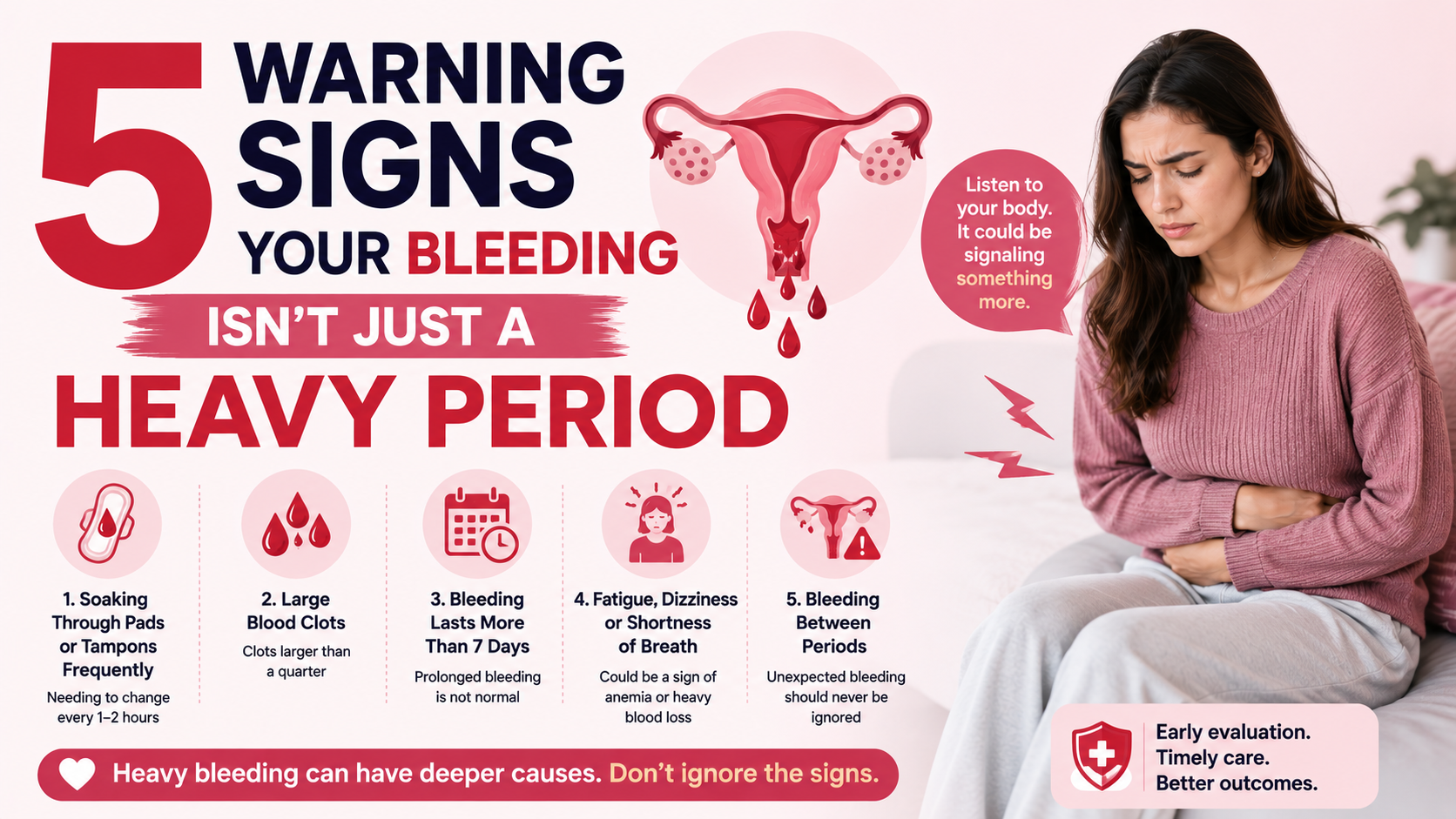
Many women experience variations in their menstrual flow from month to month. However, constantly dealing with an overwhelming flow can disrupt your life and mask serious, underlying medical issues. It is easy to normalize severe fatigue or constant pad changes, but understanding when your Bleeding Isn’t Just a Heavy Period is crucial for protecting your health and well-being.
Abnormally heavy menstrual bleeding, clinically known as menorrhagia, is a common issue, but it should never be ignored. When your body exhibits specific, extreme warning signs, it often indicates conditions like uterine fibroids, endometrial polyps, hormonal imbalances, or bleeding disorders. Let’s break down five critical warning signs that prove your Bleeding Isn’t Just a Heavy Period and explore when to consult a specialist.
1. You Soak Through Protection Every Hour for Consecutive Hours
Normal menstruation requires changing a pad or tampon every few hours. However, if your Bleeding Isn’t Just a Heavy Period, you will find yourself soaking through one or more sanitary pads or tampons every single hour for a consecutive block of time. Needing to wear double protection—such as a tampon and a heavy pad simultaneously—is a major red flag that your flow has crossed a safe threshold.
2. You Frequently Pass Large Blood Clots
While passing tiny blood clots during the heaviest days of your cycle can happen, the size of the clots matters significantly. If your Bleeding Isn’t Just a Heavy Period, you will frequently pass dark red blood clots that are larger than a quarter or a coin. Large clots indicate that your body’s natural anti-coagulant mechanisms are overwhelmed by the rapid velocity of the blood flow, requiring a medical evaluation.
3. Your Menstrual Flow Wakes You Up Multiple Times at Night
A standard menstrual flow should allow you to sleep comfortably through the night with overnight protection. If your Bleeding Isn’t Just a Heavy Period, your sleep will be regularly disrupted. Finding yourself waking up multiple times during the night just to change your sanitary protection, or frequently ruining your bed linens despite using overnight pads, indicates an abnormally high volume of blood loss.
4. Your Menstrual Bleeding Lasts Longer Than Seven Continuous Days
A healthy menstrual cycle typically ranges between three to seven days. When your Bleeding Isn’t Just a Heavy Period, your cycle will regularly stretch beyond a full week. Bleeding or spotting that continues past eight days puts immense physical strain on your reproductive system and can point to issues like adenomyosis or a thick uterine lining.
5. You Experience Symptoms of Anemia, Chronic Fatigue, and Shortness of Breath
Losing excessive amounts of blood month after month depletes your body’s iron stores, dropping your red blood cell count. If your Bleeding Isn’t Just a Heavy Period, you will experience clear signs of iron-deficiency anemia.
> **Warning Symptoms:** Feeling constantly exhausted, experiencing shortness of breath during mild activities, having unusually pale skin, or feeling dizzy when standing up are clear signs that your blood loss is impacting your overall health.
Normal Menstruation vs. Abnormal Flow
| Normal Period | When It’s Something More |
| Lasts 3–7 days | Extends beyond 7 days |
| Changes protection every 3–4 hours | Soaks through pads every hour |
| Small, occasional blood clots | Large clots (larger than a coin) |
| Allows uninterrupted night sleep | Requires waking up to change |
Histopathological Foundations of Abnormal Uterine Bleeding (AUB)
Abnormal Uterine Bleeding (AUB) represents an interruption in the structural, vascular, or endocrine regulation of the endometrium. While heavy period symptoms are frequently dismissed as temporary hormonal fluctuations, histopathological mechanisms often drive persistent blood loss:
┌─────────────────────────────────────────────────────────────────────────────┐
│              Histopathological Pathways of Abnormal Uterine Bleeding        │
├─────────────────────────────────────────────────────────────────────────────┤
│ 1. Angiogenesis Dysregulation                                              │
│    • Overexpression of VEGF and basic fibroblast growth factor (bFGF)       │
│    • Creation of fragile, dilated microvessels prone to spontaneous rupture │
│                                                                             │
│ 2. Endometrial Matrix Metalloproteinase (MMP) Activation                   │
│    • Uncontrolled breakdown of extracellular matrix components              │
│    • Delayed focal tissue repair following routine shedding                 │
│                                                                             │
│ 3. Myometrial Contractility Deficits                                        │
│    • Structural distortion by intramural fibroids or adenomyotic foci        │
│    • Impaired mechanical compression of spiral arteries ("physiological     │
│      hemostatic clamps")                                                    │
└─────────────────────────────────────────────────────────────────────────────┘
Angiogenesis Dysregulation and Fragile Microvessels
Normal menstruation ends when localized vasoconstriction, platelet aggregation, and vessel repair stop bleeding. In pathological states, local expression of Vascular Endothelial Growth Factor (VEGF) increases. This causes disorganized vessel formation within the functional endometrial layer. These thin-walled, fragile capillaries lack supporting pericyte coverage and break easily under routine intra-abdominal pressure, causing prolonged bleeding.
Myometrial Contractility Deficits
The uterus relies on mechanical compression to stop blood flow: as the myometrium contracts around spiral arteries, it acts as a set of biological clamps. When conditions such as intramural fibroids, diffuse adenomyosis, or deep infiltrating lesions alter the structural architecture of the uterine wall, these muscle contractions become ineffective. Spiral arteries remain wide open, converting routine monthly shedding into heavy, continuous blood loss.
PALM-COEIN Classification: Beyond Basic Diagnostics
To move past generic terms like “menorrhagia,” the International Federation of Gynecology and Obstetrics (FIGO) established the PALM-COEIN classification system. This framework categorizes conditions into structural causes (PALM) that can be identified via imaging or histology, and non-structural causes (COEIN) linked to systemic, clotting, or hormonal imbalances.
                        [FIGO PALM-COEIN Architecture]
                                      │
     ┌────────────────────────────────┴────────────────────────────────┐
     ▼                                                                 ▼
[PALM: Structural Etiologies]                     [COEIN: Non-Structural Etiologies]
- P: Polyp (Endometrial / Cervical)               - C: Coagulopathy (e.g., von Willebrand)
- A: Adenomyosis (Endometrial invasion)           - O: Ovulatory Dysfunction (PCOS, Thyroid)
- L: Leiomyoma (Submucosal vs. Other Fibroids)    - E: Endometrial Primary Dysfunction
- M: Malignancy & Hyperplasia                     - I: Iatrogenic (IUCDs, Anticoagulants)
                                                  - N: Not Yet Classified
| Classification Element | Pathophysiological Mechanism | Clinical & Diagnostic Indicators |
| Polyps ($\text{AUB-P}$) | Localized epithelial overgrowth surrounding a vascular core | Intermenstrual spotting, post-coital bleeding, clear visualization on saline-infusion sonography (SIS) |
| Adenomyosis ($\text{AUB-A}$) | Ectopic endometrial glands and stroma embedded within the myometrium | Severe dysmenorrhea, globally enlarged “globular” uterus, junctional zone thickening $>12\text{ mm}$ on MRI |
| Leiomyoma ($\text{AUB-L}$) | Benign smooth muscle tumors distorting the uterine cavity or impinging on vessels | Heavy bleeding with large clots, pelvic pressure, frequent urination, direct visualization via 3D ultrasound |
| Coagulopathy ($\text{AUB-C}$) | Inherited or acquired defects in systemic hemostasis (e.g., von Willebrand Disease) | Heavy menstrual bleeding since menarche, easy bruising, prolonged bleeding after dental or surgical procedures |
| Ovulatory Dysfunction ($\text{AUB-O}$) | Unopposed estrogen caused by anovulatory cycles (PCOS, thyroid disease, perimenopause) | Irregular cycle lengths, sudden heavy flow after months of amenorrhea, variable blood volume |
Hematological Consequences: Chronic Anemia and Tissue Hypoxia
Unmanaged heavy bleeding can drain bodily iron stores, moving beyond a localized gynecological problem to cause systemic iron-deficiency anemia.
  [Heavy Monthly Blood Loss] ──> [Serum Ferritin Depletion] ──> [Impaired Erythropoiesis]
              │                                                             │
              ▼                                                             ▼
  [Red Cell Microcytosis]  <─── [Hemoglobin Drops <12 g/dL]  <─── [Systemic Tissue Hypoxia]
The Functional Iron Cascade
The body holds approximately $3\text{–}4\text{ grams}$ of elemental iron, largely bound within hemoglobin inside circulating red blood cells. A normal menstrual cycle results in an iron loss of about $15\text{–}30\text{ mg}$ per month. However, when blood loss exceeds $80\text{ mL}$ per cycle, iron loss can rise above $50\text{–}100\text{ mg}$ per month.
-
Stage 1 (Iron Depletion): Bone marrow reserves and serum ferritin drop below $30\text{ ng/mL}$, though serum hemoglobin levels may still appear normal.
-
Stage 2 (Iron Deficient Erythropoiesis): Serum iron and transferrin saturation levels decrease. Bone marrow cannot produce enough hemoglobin for new red blood cells.
-
Stage 3 (Iron Deficiency Anemia): Hemoglobin levels drop below $12\text{ g/dL}$. Red blood cells become microcytic (unusually small) and hypochromic (pale), reducing the blood’s capacity to transport oxygen.
Systemic Signs of Tissue Hypoxia
As tissue oxygenation falls, patients may experience progressive, systemic symptoms that go beyond typical period fatigue:
-
Cardiovascular Strain: Exertional dyspnea, sinus tachycardia, palpitations, and compensatory orthostatic dizziness.
-
Neurological Impact: Cognitive slowing, chronic headaches, restless legs syndrome (RLS), and poor sleep quality.
-
Epithelial Changes: Angular cheilitis (cracks at the corners of the mouth), brittle or spoon-shaped nails (koilonychia), and diffuse hair thinning.
Non-Invasive & Advanced Interventional Modalities
Modern gynecology offers targeted medical and surgical options to manage abnormal bleeding, moving away from immediate, major surgery.
                           [Spectrum of Medical & Surgical Interventions]
                                                 │
     ┌───────────────────────────────────────────┼───────────────────────────────────────────┐
     ▼                                           ▼                                           ▼
[Non-Hormonal & Hormonal Medical]       [Outpatient & Uterine-Sparing]              [Advanced Surgical Management]
- Tranexamic Acid (Antifibrinolytic)   - LNG-IUS (Levonorgestrel IUD placement)   - Robotic/Laparoscopic Myomectomy
- Mefenamic Acid (NSAID therapy)       - Hysteroscopic Polyp/Fibroid Resection    - Robotic Total/Subtotal Hysterectomy
- Combined Hormonal Contraception      - Minimally Invasive Endometrial Ablation   - Uterine Artery Embolization (UAE)
Non-Hormonal and Hormonal Medical Options
-
Tranexamic Acid: A lysine analog that competitively inhibits plasminogen activation, slowing fibrin breakdown within endometrial microvessels. It reduces menstrual blood loss by up to $40\text{–}50\%$ without altering systemic hormone levels.
-
Levonorgestrel Intrauterine System (LNG-IUS): Releases low daily doses of progestin directly into the uterine cavity. This induces endometrial atrophy and reduces local vascular density, lowering menstrual blood loss by over $80\text{–}90\%$ within six months of insertion.
Minimally Invasive and Robotic Interventions
-
Hysteroscopic Resection (TCRM/TCRP): A camera and specialized wire loop are passed through the cervix to remove submucosal fibroids or endometrial polyps under direct vision, preserving surrounding normal tissue.
-
Robotic-Assisted Myomectomy or Hysterectomy: For complex cases with deep intramural fibroids, diffuse adenomyosis, or dense pelvic adhesions, robotic surgical systems offer 3D high-definition visualization and wristed instrumentation. This enables precise tissue dissection, minimal blood loss, and faster postoperative recovery compared to traditional open surgery.
Diagnostic Workflow for Unexplained Heavy Bleeding
Evaluating abnormal uterine bleeding requires a systematic diagnostic approach to identify the root cause before starting treatment.
┌─────────────────────────────────────────────────────────────────────────────┐
│                   Diagnostic Diagnostic Workflow                            │
├─────────────────────────────────────────────────────────────────────────────┤
│ 1. Targeted Triage & Initial Lab Panel                                       │
│    • Complete Blood Count (CBC) with red cell indices                        │
│    • Serum Ferritin, Iron Studies, Total Iron Binding Capacity (TIBC)       │
│    • Coagulation Profile (PT/INR, aPTT, von Willebrand factor screening)    │
│    • Thyroid-Stimulating Hormone (TSH) and Serum Prolactin                   │
│                                                                             │
│ 2. High-Resolution Pelvic Imaging                                           │
│    • Transvaginal Ultrasonography (TVUS) with color Doppler                 │
│    • Saline Infusion Sonography (SIS) for intracavitary lesion mapping      │
│    • Pelvic MRI for junctional zone mapping and complex fibroid planning    │
│                                                                             │
│ 3. Tissue Sampling & Direct Endometrial Evaluation                          │
│    • In-office Pipelle endometrial biopsy                                   │
│    • Office Diagnostic Hysteroscopy with targeted tissue biopsy              │
└─────────────────────────────────────────────────────────────────────────────┘
Indications for Endometrial Sampling
Endometrial tissue sampling is essential to rule out premalignant atypical hyperplasia or endometrial carcinoma in specific risk groups:
-
All women over 40 years of age presenting with abnormal uterine bleeding.
-
Women under 40 years of age with risk factors for persistent unopposed estrogen exposure, such as chronic anovulation in Polycystic Ovary Syndrome (PCOS), severe obesity ($\text{BMI} \ge 30\text{ kg/m}^2$), or a family history of Lynch syndrome.
-
Patients whose bleeding does not respond to standard first-line medical therapy.
World-Class Care for Abnormal Bleeding: Dr. Preeti Rastogi
Managing persistent or severe abnormal uterine bleeding requires expert clinical evaluation, accurate diagnosis, and personalized treatment options. Widely recognized as the best gynaecologist in gurugram, Dr. Preeti Rastogi brings advanced international experience to complex women’s health conditions.
┌─────────────────────────────────────────────────────────────────────────────┐
│                 Dr. Preeti Rastogi: Clinical Qualifications                 │
├─────────────────────────────────────────────────────────────────────────────┤
│ • Leadership: Director & Head of Department, Obstetrics & Gynaecology       │
│   at Medanta – The Medicity, Gurugram                   │
│ • International Credentials: Over 10 years of senior practice in top UK     │
│   hospitals; holds MRCOG (London, UK) and specialized fellowships in         │
│   Minimal Access Surgery, Urogynecology, and High-Risk Obstetrics│
│ • Surgical Mastery: Certified Da Vinci Xi Robotic Surgeon specializing in   │
│   hysteroscopic resections, laparoscopic myomectomy, and organ-preserving   │
│   surgeries                                             │
│ • Patient Care: Focused on accurate PALM-COEIN diagnosis, uterine-sparing   │
│   treatments, and evidence-based clinical management    │
└─────────────────────────────────────────────────────────────────────────────┘
Specialized Care for Complex Menstrual Disorders
Dr. Preeti Rastogi leads a multidisciplinary team providing specialized care for severe menstrual conditions:
-
Advanced Diagnostic Evaluations: Comprehensive assessment using high-resolution transvaginal sonography, hysteroscopy, and targeted endometrial biopsies.
-
Personalized Uterine-Sparing Therapies: Non-surgical options including LNG-IUS placement, targeted anti-fibrinolytic protocols, and medical management of adenomyosis.
-
Robotic & Minimal Access Surgical Precision: Expert surgical care using the Da Vinci Xi system for complex fibroids, severe endometriosis, and large uteri.
Her clinical expertise, UK NHS background, and commitment to compassionate patient care establish her as the best gynaecologist in gurugram.
About Dr. Preeti Rastogi
-
Current Position: Director and Head of the Department of Obstetrics and Gynaecology at Medanta – The Medicity, Gurgaon.
-
Global Experience: Over 30 years of elite clinical expertise practicing across premium tertiary hospitals in India and the United Kingdom (including 10 years at the University Hospital of Wales, Cardiff).
-
Specialized Expertise: Expert in high-risk obstetrics, complex pelvic reconstructive surgery, minimal access laparoscopic procedures, and robotic-assisted gynaecological interventions.
-
Robotic Surgical Credentials: Certified Da Vinci Xi Robotic Surgeon, utilizing high-precision robotic technology to treat complex conditions like deep infiltrating endometriosis and large uterine fibroids.
-
Academic Credentials: Earned her prestigious MRCOG from the Royal College of Obstetricians and Gynaecologists (UK) and a DNB in Obstetrics and Gynaecology from St. Stephen’s Hospital, Delhi.
Taking Control of Your Reproductive Health
If you recognize these symptoms in your monthly cycle, remember that severe blood loss is a treatable medical condition. Realizing that your Bleeding Isn’t Just a Heavy Period allows you to stop suffering in silence and seek answers. Consulting a dedicated specialist ensures you receive an accurate diagnosis, prevent chronic anemia, and find a personalized treatment plan to reclaim your quality of life.
#AbnormalUterineBleeding #MenorrhagiaSymptoms2026 #UterineFibroidsDiagnosis #PassingLargeBloodClots #IronDeficiencyAnemiaSigns #ChronicMenstrualFatigue #ProlongedPeriodsTreatment #DrPreetiRastogiGynecology #MedantaHospitalGurgaon #BestGynaeGurugram #EndometrialPolypsRemoval #HysteroscopySurgeryIndia #RoboticGynaeSurgeon #PelvicUltrasoundScan #AdenomyosisSymptoms #HormonalImbalanceWomen #ThyroidAndPeriods #HeavyMenstrualBleeding #WomenHealthcareExpert #UterineLiningThickening #MenstrualCycleTracking #AntiCoagulantMechanism #PelvicInflammatoryDisease #MinimallyInvasiveGynae #GynaecologyExpertsGurgaon #HighRiskObstetricsDoctor #RoyalCollegeGynaeUK #DaVinciXiRoboticGynae #DizzinessDuringPeriod #SanitaryProtectionOverload #MenstrualHealthAwareness
FAQ
Q1: What signs indicate that my Bleeding Isn’t Just a Heavy Period?
A: Warning signs that your Bleeding Isn’t Just a Heavy Period include soaking through one or more sanitary pads every hour for several hours, passing blood clots larger than a coin, bleeding for more than seven continuous days, waking up at night to change protection, and experiencing anemia symptoms like dizziness or chronic fatigue.
Q2: What causes abnormal menstrual flow if the Bleeding Isn’t Just a Heavy Period?
A: When your Bleeding Isn’t Just a Heavy Period, the underlying causes commonly include uterine fibroids, endometrial polyps, adenomyosis, severe hormonal imbalances (like thyroid disorders or PCOS), pelvic inflammatory disease, or non-cancerous growths within the uterine lining.
Q3: Why is Dr. Preeti Rastogi considered the best gynecologist in Gurgaon for heavy bleeding treatment?
A: Dr. Preeti Rastogi is widely recognized as the best gynecologist in Gurgaon due to her 30+ years of clinical experience in India and the UK. As the Director of Obstetrics and Gynaecology at Medanta – The Medicity, she specializes in advanced laparoscopy, hysteroscopy, and robotic surgeries, providing exceptional care for complex menstrual disorders.
Q4: How does Dr. Preeti Rastogi diagnose conditions when Bleeding Isn’t Just a Heavy Period?
A: Dr. Preeti Rastogi performs a comprehensive clinical evaluation, which may include advanced transvaginal ultrasounds, pelvic MRIs, endometrial biopsies, or a diagnostic hysteroscopy. This precise mapping ensures she identifies the exact root cause of the abnormal bleeding to structure an effective care plan.
Q5: What medical treatments are available when Bleeding Isn’t Just a Heavy Period?
A: Treatments depend entirely on the root cause and can range from hormonal therapies and non-hormonal medications to minimally invasive procedures. Dr. Preeti Rastogi offers advanced options like hysteroscopic polyp removal, uterine fibroid embolization, or laparoscopic and robotic surgeries to resolve heavy bleeding while prioritizing patient safety.