Understanding the Signs of Prolapsed Uterus: Stages, Risks, and When to Consider Surgery
Pelvic health forms the core of a woman’s physical well-being, yet structural changes within the pelvic floor often go unaddressed due to hesitation or lack of awareness. Uterine prolapse occurs when the pelvic floor muscles, ligaments, and fascia weaken, causing the uterus to slip down into or protrude beyond the vaginal canal. Recognizing early signs of prolapsed uterus is essential for timely intervention, preserving quality of life, and preventing progressive pelvic floor dysfunction.
This comprehensive guide details the anatomical stages, potential health risks, conservative management options, and key indicators for surgical intervention.
1. Primary Signs of Prolapsed Uterus to Watch For
Understanding the initial signs of prolapsed uterus allows women to seek medical evaluation before the condition advances to severe stages. Symptoms vary depending on whether the prolapse is mild, moderate, or advanced.
┌─────────────────────────────────────────────────────────────┐
│                 Pelvic Symptom Progression                  │
└──────────────────────────────┬──────────────────────────────┘
                               │
       ┌───────────────────────┼───────────────────────┐
       ▼                       ▼                       ▼
┌──────────────┐       ┌───────────────┐       ┌───────────────┐
│ Mild / Early │       │   Moderate    │       │   Advanced    │
│ Inner Pelvic │ ────► │ Vaginal Bulge │ ────► │  Protrusion   │
│ Heavy Sensation│     │   & Pressure  │       │ & Tissue Pain │
└──────────────┘       └───────────────┘       └───────────────┘
-
Sensation of Pelvic Heaviness or Pulling: A common early sign of prolapsed uterus is a dull ache, dragging feeling, or fullness in the lower abdomen and pelvis, often worsening after prolonged standing or walking.
-
Visible or Palpable Vaginal Bulge: As pelvic support weakens, a soft tissue bulge may be felt or seen at the vaginal opening.
-
Urinary Incontinence and Dysfunction: Displacement of pelvic organs affects bladder support, leading to stress urinary incontinence (leaking urine when coughing or laughing), frequent urges, or difficulty emptying the bladder completely.
-
Bowel Irregularities and Constipation: A sagging uterus can press against the rectum, causing difficulty with bowel movements or a sensation of incomplete evacuation.
-
Discomfort During Sexual Intercourse: Structural changes often lead to deep pelvic pain, looseness, or discomfort during intimacy.
-
Lower Back Pain: Strain on pelvic ligaments frequently radiates into the lower back, typically easing when lying down.
2. Anatomical Stages of Pelvic Organ Prolapse
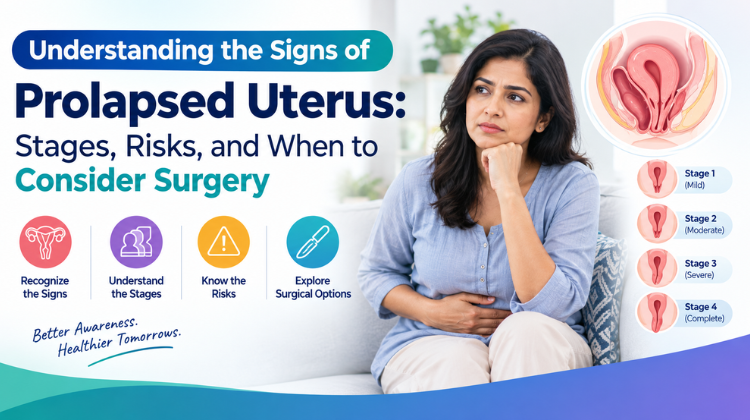
Medical professionals grade uterine prolapse across four distinct stages based on how far the uterus has descended relative to the hymenal ring:
| Stage | Anatomical Classification | Severity & Characteristics |
| Stage I | Upper Vaginal Descent | The uterus descends into the upper portion of the vagina. Often asymptomatic and detected during routine pelvic exams. |
| Stage II | Lower Vaginal Descent | The cervix or uterus descends close to the opening of the vagina (hymenal ring). Sensation of fullness or mild bulge becomes noticeable. |
| Stage III | External Protrusion | The cervix or uterus extends outside the vaginal opening. Tissue friction, discomfort, and noticeable signs of prolapsed uterus occur daily. |
| Stage IV | Procidentia (Complete Prolapse) | The entire uterus hangs outside the vagina. Accompanied by chronic tissue exposure, ulceration, severe urinary obstruction, and mobility challenges. |
3. Causes and Risk Factors Behind Pelvic Floor Weakness
A combination of mechanical strain, hormonal shifts, and structural factors can cause the pelvic floor to lose elasticity over time:
-
Pregnancy and Vaginal Childbirth: Multiple pregnancies, prolonged labor, or delivering high-birth-weight infants stretch pelvic supporting tissues.
-
Chronic Intra-Abdominal Pressure: Persistent coughing (from asthma or smoking), recurrent constipation with straining, and frequent heavy lifting place continuous stress on the pelvic ligaments.
-
Menopause and Estrogen Decline: Reduced estrogen levels post-menopause lead to thinning and loss of elasticity in pelvic connective tissues.
-
Connective Tissue Disorders: Genetic conditions like Ehlers-Danlos or Marfan syndrome weaken collagen structure throughout the body.
-
Prior Pelvic Surgeries: Previous procedures like hysterectomies can alter internal support structures, increasing susceptibility to prolapse. Understanding the Signs of Prolapsed Uterus: Stages, Risks, and When to Consider Surgery
4. Comparing Treatment Options: Non-Surgical vs. Surgical Solutions
Treatment depends on the severity of the prolapse, the presence of bothersome signs of prolapsed uterus, and the patient’s general health and lifestyle goals.
┌─────────────────────────────────────────────────────────────────┐
│                 Treatment Selection Matrix                      │
├─────────────────────────────────────────────────────────────────┤
│                                                                 │
│   Stage I & II (Asymptomatic / Mild)                            │
│   ├── Pelvic Floor Muscle Training (Kegels)                     │
│   └── Vaginal Pessary Insertion                                 │
│                                                                 │
│   Stage III & IV (Symptomatic / Severe Protrusion)             │
│   ├── Uterine-Preserving Sacrospinous Hysteropexy               │
│   └── Minimally Invasive / Robotic Sacrocolpopexy (Hysterectomy)│
│                                                                 │
└─────────────────────────────────────────────────────────────────┘
Non-Surgical Management (Stage I & II)
-
Pelvic Floor Muscle Training (Kegel Exercises): Strengthens the levator ani muscle complex to prevent further descent in early-stage cases.
-
Vaginal Pessary Therapy: A removable silicone device inserted into the vagina to provide structural support to the uterus and bladder.
-
Lifestyle & Dietary Adjustments: Managing weight, preventing constipation through high-fiber diets, and avoiding heavy lifting helps reduce intra-abdominal strain. Understanding the Signs of Prolapsed Uterus: Stages, Risks, and When to Consider Surgery
Surgical Intervention (Stage III & IV or Failed Conservative Care)
When non-surgical therapies fail to relieve persistent signs of prolapsed uterus, surgical restoration is considered:
-
Uterine-Preserving Prolapse Repair (Hysteropexy): Secures the native uterus back into its correct anatomical position using permanent sutures or synthetic mesh.
-
Vaginal or Laparoscopic Hysterectomy with Pelvic Floor Reconstruction: Removes the descended uterus and repairs weak vaginal walls (anterior and posterior colporrhaphy) to rebuild the pelvic floor.
-
Robotic Sacrocolpopexy: A state-of-the-art, minimally invasive approach using robotic technology to fix the pelvic structure to the sacrum with high precision and minimal recovery time. Understanding the Signs of Prolapsed Uterus: Stages, Risks, and When to Consider Surgery
5. Critical Indicators: When to Consider Surgery for Prolapsed Uterus
Determining when to transition from conservative management to surgical correction involves evaluating several key factors:
-
Persistent External Tissue Protrusion: When the cervix or uterus visibly extends outside the body, causing chronic dryness, bleeding, or ulceration.
-
Severe Urinary Retention or Recurrent Infections: Inability to empty the bladder completely can cause urine stagnation, leading to kidney strain or recurrent urinary tract infections (UTIs).
-
Inability to Retain a Vaginal Pessary: If severe pelvic floor weakness prevents a pessary from staying in place, surgery becomes the primary corrective option.
-
Significant Discomfort Impacting Daily Life: Pain, immobility, or severe pelvic pressure that restricts walking, exercise, or daily activities warrants a surgical consultation.
-
Desire for Definitive Anatomical Restoration: Patients seeking a permanent structural repair often prefer corrective surgery over lifelong pessary care. Understanding the Signs of Prolapsed Uterus: Stages, Risks, and When to Consider Surgery
#Pelvic Organ Prolapse #Uterine Prolapse #Pelvic Floor Dysfunction #Vaginal Prolapse #Pelvic Heaviness #Prolapsed Uterus Treatment #Pelvic Floor Reconstruction #Da Vinci Robotic Surgery #Gynecologist In Gurgaon #Dr Preeti Rastogi #Medanta Gurgaon #Urogynecology #Hysteropexy #Sacrocolpopexy #Laparoscopic Gynecology #Vaginal Pessary #Kegel Exercises #Urinary Incontinence #Pelvic Health Women #Stage 3 Prolapse #Procidentia #Minimally Invasive Gynecology #Gurgaon Gynecologist #Women Health Gurugram #Pelvic Prolapse Repair #Gynecologic Surgeon #Pelvic Floor Physical Therapy #Robotic Hysterectomy #Surgical Prolapse Repair #Pelvic Organ Descent
FAQ
Q1: What are the primary signs of prolapsed uterus that indicate a need for medical evaluation?
Answer:
The primary signs of prolapsed uterus include a persistent sensation of heavy pelvic dragging, a visible bulge protruding from the vaginal opening, urinary incontinence, bowel movement difficulties, chronic lower back pain, and discomfort during intercourse. If you notice a palpable tissue mass or experience urinary retention, consult a specialized gynecologist for evaluation. Understanding the Signs of Prolapsed Uterus: Stages, Risks, and When to Consider Surgery
Q2: Who is Dr. Preeti Rastogi, and why is she recommended for treating uterine prolapse in Gurgaon?
Answer:
Dr. Preeti Rastogi is a renowned Obstetrician, Gynecologist, and certified Da Vinci Xi Robotic Surgeon with over 25 years of global clinical experience. Serving as Director and Head of Department in Obstetrics and Gynaecology at Medanta – The Medicity, Gurgaon, she specializes in urogynecology, minimally invasive laparoscopic procedures, and robotic pelvic floor reconstruction. Understanding the Signs of Prolapsed Uterus: Stages, Risks, and When to Consider Surgery
Q3: What qualifications and achievements distinguish Dr. Preeti Rastogi in pelvic floor reconstructive surgery?
Answer:
Dr. Preeti Rastogi earned her MBBS from Jiwaji University, DNB from the National Board of Examinations, and MRCOG from the Royal College of Obstetricians and Gynaecologists, London. Having worked for over a decade in prestigious UK hospitals—including the University Hospital of Wales, Cardiff—she brings advanced international expertise to complex pelvic repairs. She is also a recognized member of the British Society of Urogynaecology. Understanding the Signs of Prolapsed Uterus: Stages, Risks, and When to Consider Surgery
Q4: When should a patient choose robotic or laparoscopic surgery with Dr. Preeti Rastogi at Medanta Gurgaon?
Answer:
Patients with Stage III or IV prolapse, recurrent pelvic floor dysfunction, or those seeking a quicker recovery with minimal scarring are ideal candidates for robotic or laparoscopic surgery. Dr. Preeti Rastogi utilizes advanced robotic platforms at Medanta to perform precise pelvic repairs, ensuring shorter hospital stays, less post-operative pain, and reduced recurrence rates. Understanding the Signs of Prolapsed Uterus: Stages, Risks, and When to Consider Surgery
Q5: Can uterine prolapse be corrected without performing a full hysterectomy?
Answer:
Yes. Depending on the patient’s age, reproductive goals, and tissue integrity, pelvic reconstructive surgeons can perform a hysteropexy (uterus-preserving surgery). This procedure re-anchors the intact uterus to strong pelvic ligaments or the sacrum, restoring normal anatomy without removing the organ. Understanding the Signs of Prolapsed Uterus: Stages, Risks, and When to Consider Surgery