The Color Guide to Vaginal Discharge
The Color Guide to Vaginal Discharge: Understanding Your Body’s Signals
Every woman experiences changes in her body throughout her monthly cycle. One of the most important, yet least discussed, indicators of reproductive health is fluid changes. Monitoring the color, consistency, and volume of your fluid can give you vital clues about your hormonal balance, fertility windows, and potential infections. This comprehensive guide breaks down what different shades mean, helping you understand when your Vaginal Discharge is completely healthy and when it is time to seek professional medical advice.
The Spectrum of Health: A Color Guide to Vaginal Discharge
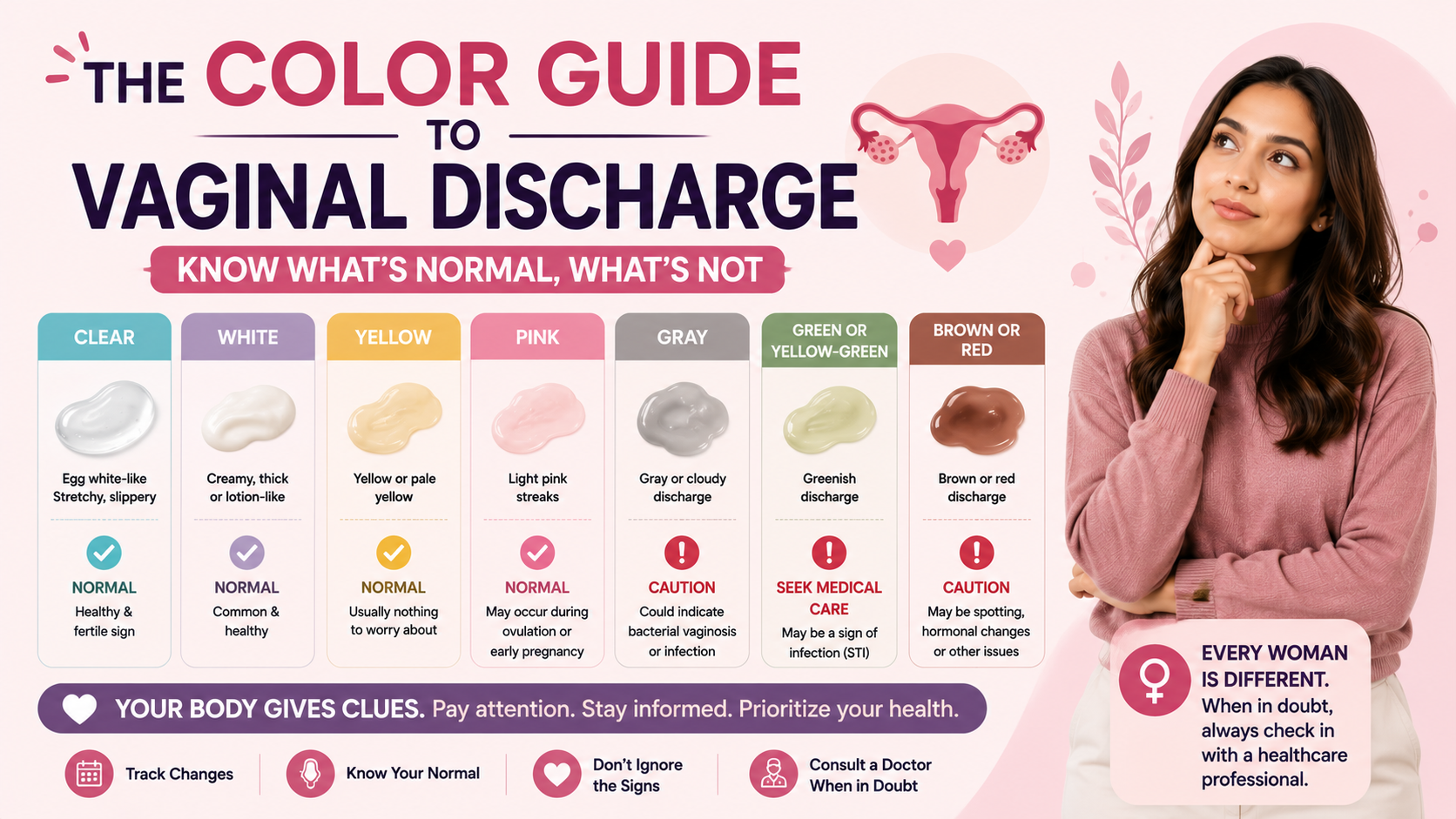
Your body naturally uses fluid production to clean and protect the reproductive tract. Normal fluid is made up of cervical mucus, vaginal secretions, and cellular debris. Depending on where you are in your menstrual cycle, the appearance of this fluid will shift. Let’s look at the different colors you might notice.
1. Clear to Milky White Fluid
In most cases, clear or milky white Vaginal Discharge is a sign of a perfectly healthy reproductive system.
-
Early Cycle: It is usually thin, watery, or slightly stretchy.
-
During Ovulation: It becomes thick and slippery, resembling raw egg whites, which indicates peak fertility.
-
As Long As It’s Odorless: White fluid is normal unless it is accompanied by intense itching, burning, or a thick, cottage cheese-like texture.
2. Light Pink to Dark Brown Fluid
Pink or brown fluid is usually tied to blood shedding.
-
Before or After Your Period: Light pink or dark brown spotting is common as your uterus prepares for or cleanses itself after a cycle.
-
During Early Pregnancy: Implantation bleeding can cause light pink spotting.
-
When to Check: If brown or bloody Vaginal Discharge occurs frequently outside your period window, persists for days, or is accompanied by pelvic pain, it requires an evaluation to rule out hormonal imbalances, polyps, or other issues.
3. Thick Gray or Foamy Greenish-Yellow Fluid
If you notice off-white, distinct gray, or yellowish-green Vaginal Discharge, your body might be fighting an imbalance or an infection.
-
Gray Fluid: A thin, dull gray fluid accompanied by a strong, fishy odor usually indicates Bacterial Vaginosis (BV), an overgrowth of normal vaginal bacteria.
-
Green or Bright Yellow Fluid: Thick, foamy, or yellowish-green Vaginal Discharge is a classic warning sign of a sexually transmitted infection (STI) like Trichomoniasis.
Identifying Abnormal Symptoms: When to See a Doctor
While variations in texture are completely normal, you should always pay attention to sudden changes. Abnormal Vaginal Discharge rarely occurs without other warning signs.
Ignoring abnormal Vaginal Discharge can lead to pelvic inflammatory disease (PID) or complications with your long-term reproductive health.
Tracking your symptoms over a couple of days can help your gynecologist provide an accurate diagnosis and treatment plan.
| Healthy Fluid | Abnormal Fluid |
| Clear, white, or light cream color | Dull gray, bright yellow, green |
| Odorless or slightly musky | Strong fishy, foul, or sour smell |
| Slippery, thin, or creamy texture | Thick like cottage cheese, foamy |
| No pain, burning, or itching | Accompanied by irritation |
Microecological Dynamics and Histological Mechanics of Vaginal Secretions
Vaginal discharge is not merely a passive physiological byproduct; it is a highly dynamic, active biochemical fluid essential to the defense mechanisms of the female reproductive tract. Formed through a complex mixture of cervical mucus, transudate from the vaginal epithelial walls, desquamated epithelial cells, and metabolic byproducts of the indigenous microflora, vaginal secretions maintain physiological equilibrium and guard against pathogenic invasion.
┌─────────────────────────────────────────────────────────────────────────────┐
│                 Biochemical Composition of Vaginal Fluid                    │
├─────────────────────────────────────────────────────────────────────────────┤
│ • Transudate: Plasma filtration across subepithelial capillary beds          │
│ • Cervical Mucus: High-molecular-weight mucin glycoproteins (MUC5B, MUC5AC) │
│ • Desquamated Epithelial Cells: Exfoliated superficial layer cells           │
│ • Lactic Acid: Produced by Lactobacillus spp. through glycogen metabolism   │
│ • Antimicrobial Peptides: Defensins, lysozyme, lactoferrin, and secretory IgA│
└─────────────────────────────────────────────────────────────────────────────┘
The Lactic Acid Cascade and pH Maintenance
In healthy reproductive-age women, the vaginal epithelium is continuously stimulated by circulating estrogen. Estrogen induces glycogen accumulation within the intermediate and superficial layers of non-keratinized stratified squamous epithelium. As these cells naturally exfoliate into the lumen, free glycogen is released and metabolized by dominant commensal bacteria—primarily Lactobacillus species (such as Lactobacillus crispatus, L. gasseri, L. jensenii, and L. iners).
Through anaerobic glycolysis, Lactobacillus species convert glycogen derivatives into lactic acid ($\text{C}_3\text{H}_6\text{O}_3$), establishing a physiological acidity range of pH 3.8 to 4.5. This acidic microenvironment serves as a critical biochemical barrier that prevents the overgrowth of opportunistic pathogens, including Gardnerella vaginalis, Candida albicans, Trichomonas vaginalis, and various anaerobic species.
Mucin Glycoproteins and Cervical Mucus Rheology
The physical characteristics of vaginal fluid vary throughout the menstrual cycle due to hormonal effects on cervical crypt cells. Cervical mucus consists of water ($90\text{–}98\%$) and gel-forming mucin glycoproteins ($\text{MUC5B}$ and $\text{MUC5AC}$).
-
Estrogenic Phase (Follicular Phase): Rising 17$\beta$-estradiol levels alter the cross-linking of mucin fibers, creating parallel channels with high water content. This produces clear, elastic, slippery mucus (spinnbarkeit) that aids sperm transport.
-
Progestogenic Phase (Luteal Phase): Progesterone alters mucin geometry into a dense, cross-linked mesh with reduced water content. This forms a viscous barrier that impedes microbial ingress and sperm penetration.
Endocrine-Driven Shifts Across the Life Course
Vaginal secretions fluctuate significantly across different reproductive stages, reflecting systemic hormonal changes.
  [Puberty/Menarche] ──> [Reproductive Years] ──> [Pregnancy] ──> [Menopause]
    Estrogen surge        Cyclic hormonal shifts    Hyperestrogenism   Estrogen drop
    Increases glycogen    Dynamic mucin changes     Leukorrhea surge   Atrophic changes
Puberty and Menarche
Prior to adrenarche and menarche, low systemic estrogen levels leave the vaginal epithelium thin, glycogen-deficient, and alkaline ($\text{pH } 6.0\text{–}7.0$). As ovarian activity begins during puberty, rising estrogen levels cause epithelial thickening, glycogen deposition, and colonization by Lactobacillus species. This shift manifests as physiological leukorrhea—a clear or off-white, non-odorous discharge that signals normal reproductive development.
Gestational Hyperestrogenism
During pregnancy, total systemic estrogen and progesterone levels rise substantially. Enhanced vascular perfusion to the pelvic organs (Chadwick’s sign) increases transudate production across the vaginal walls. Combined with hyperplastic cervical glandular activity, this produces heavy, white or milky, non-irritating discharge known as physiological leukorrhea of pregnancy. This increased flow clears cellular debris and helps protect the uterine cavity from ascending lower genital tract infections.
Postmenopausal Epithelial Atrophy
During perimenopause and menopause, declining follicular activity leads to a loss of circulating estrogen. The vaginal mucosa thins to a few cell layers, glycogen production drops sharply, and Lactobacillus populations diminish.
-
The vaginal pH rises to 5.5–7.0.
-
Physiological secretions decrease, causing vaginal dryness (vulvovaginal atrophy).
-
Reduced acidity allows secondary colonization by enteric organisms, increasing the risk of genitourinary syndrome of menopause (GSM), inflammatory vaginitis, and recurrent urinary tract infections.
Diagnostic Evaluation: Microscopic and Biochemical Profiling
Accurately evaluating abnormal vaginal discharge requires combining clinical history with point-of-care laboratory diagnostic protocols. Relying on visual appearance alone often leads to misdiagnosis, as symptoms can overlap across infectious and non-infectious etiologies.
┌─────────────────────────────────────────────────────────────────────────────┐
│                    Diagnostic Diagnostic Workflow                         │
├─────────────────────────────────────────────────────────────────────────────┤
│ 1. Visual & Physical Inspection: Color, viscosity, consistency, volume     │
│ 2. pH Measurement: Narrow-range indicator paper (pH 3.0 to 7.0)             │
│ 3. Whiff Test (Amine Test): 10% KOH added to sample (fishy odor check)      │
│ 4. Saline Wet Mount Microscopy: Clue cells, motile trichomonads, PMNs       │
│ 5. 10% KOH Wet Mount Microscopy: Hyphae, pseudohyphae, and blastospores      │
└─────────────────────────────────────────────────────────────────────────────┘
| Diagnostic Parameter | Normal Physiological Discharge | Bacterial Vaginosis (BV) | Vulvovaginal Candidiasis (VVC) | Trichomoniasis |
| Vaginal pH | $3.8\text{–}4.5$ | $>4.5$ | $4.0\text{–}4.5$ (Normal) | $>4.5\text{–}5.0$ |
| Amine “Whiff” Test ($10\%\text{ KOH}$) | Negative | Positive (Fishy odor) | Negative | Frequently Positive |
| Microscopic Findings (Saline) | Epithelial cells, predominant lactobacilli | Clue cells $>20\%$, reduced lactobacilli | Normal epithelial cells, lactobacilli present | Motile flagellated protozoa, PMNs |
| Microscopic Findings ($10\%\text{ KOH}$) | No fungal elements | No fungal elements | Pseudohyphae, budding yeast cells | No fungal elements |
| Inflammatory Response | Absent | Absent (Minimal PMNs) | Moderate to severe PMNs | Marked PMNs (Leukorrhea) |
Saline and KOH Wet Mount Analysis
-
Clue Cells: Vaginal epithelial cells covered with adherent Gardnerella vaginalis and anaerobic bacteria, obscuring the distinct cell borders. A presence of $>20\%$ clue cells on wet mount is a key diagnostic criterion for Bacterial Vaginosis (Amsel’s criteria).
-
Fungal Structures: Adding $10\%\text{ potassium hydroxide (KOH)}$ dissolves epithelial cells and leukocytes while leaving fungal cell walls intact. This exposes pseudohyphae and budding blastospores typical of Candida albicans.
-
Motile Protozoa: Fresh, unheated saline wet mounts reveal flagellated, oval Trichomonas vaginalis organisms displaying active, jerky motility alongside abundant polymorphonuclear leukocytes (PMNs).
Color-Coded Etiological Matrix: Pathophysiology and Clinical Correlations
The color, texture, and odor of vaginal discharge reflect underlying microbial activity, structural inflammation, or hormonal fluctuations.
                             [Vaginal Discharge Color Matrix]
                                            │
     ┌───────────────────┬──────────────────┼───────────────────┬──────────────────┐
     ▼                   ▼                  ▼                   ▼                  ▼
[Clear / White]    [Thick White]    [Yellow / Green]     [Pink / Red]     [Gray / Frothy]
Normal Cycle       Candidiasis      Trichomoniasis/STI   Blood/Spotting   Bacterial Vaginosis
(Estrogen Peak)    (Fungal Overgrowth) (Infection/PMNs)  (Cervical/Uterine) (Anaerobic Imbalance)
1. Clear, Elastic, or Watery Discharge
-
Physiological Context: Occurs during the pre-ovulatory estrogen surge (mid-cycle), sexual arousal, or intense physical exertion.
-
Mechanism: High circulating estrogen expands cervical crypt openings and alters mucin fiber arrangements, resulting in clear, stretchy, non-odorous discharge designed to support sperm passage.
2. Thick, Cottage Cheese-Like White Discharge
-
Clinical Context: Vulvovaginal Candidiasis (VVC).
-
Mechanism: Disruption of the local flora—often triggered by broad-spectrum antibiotic use, uncontrolled diabetes mellitus, elevated estrogen levels, or immunosuppression—allows Candida albicans to shift from a commensal yeast form to an invasive hyphal form. This triggers epithelial inflammation, causing intense vulvar itching, burning, dyspareunia, and clumpy, odorless discharge.
3. Thin, Homogeneous Off-White or Gray Discharge
-
Clinical Context: Bacterial Vaginosis (BV).
-
Mechanism: A reduction in hydrogen peroxide-producing Lactobacillus species leads to an overgrowth of facultative and anaerobic bacteria (Gardnerella vaginalis, Atopobium vaginae, Mobiluncus species, and Prevotella). These anaerobes produce polyamines (putrescine and cadaverine), which volatilize and release a characteristic fishy odor, particularly when mixed with alkaline fluids such as semen or $10\%\text{ KOH}$.
4. Frothy, Yellow-Green, or Purulent Discharge
-
Clinical Context: Trichomoniasis or Cervicitis (e.g., Neisseria gonorrhoeae or Chlamydia trachomatis).
-
Mechanism: Infection with Trichomonas vaginalis causes significant inflammation of the vaginal and cervical mucosa, resulting in a frothy, malodorous yellow-green discharge accompanied by punctate cervical hemorrhages (“strawberry cervix”). Similarly, purulent mucopurulent discharge originating from the cervical os indicates bacterial cervicitis requiring targeted antimicrobial therapy.
5. Pink, Brown, or Dark Red Discharge
-
Clinical Context: Intermenstrual spotting, cervical lesions, implantation bleeding, or endometrial pathology.
-
Mechanism: Pink or brown discharge results from small amounts of blood mixing with normal vaginal secretions. Slow transit through the acidic vaginal cavity oxidizes hemoglobin into methemoglobin, turning the fluid brown. While often benign (such as mid-cycle ovulation spotting or breakthrough bleeding from hormonal contraceptives), persistent or post-coital brown discharge warrants structural evaluation to rule out cervical polyps, dysplasia, or endometrial abnormalities.
Non-Infectious Etiologies: Inflammatory, Desquamative, and Mechanical Drivers
Not all abnormal vaginal discharge stems from classical lower genital tract infections. Several non-infectious structural, mechanical, and inflammatory conditions can significantly alter the volume, color, and consistency of vaginal fluid.
┌─────────────────────────────────────────────────────────────────────────────┐
│                    Non-Infectious Drivers of Discharge                      │
├─────────────────────────────────────────────────────────────────────────────┤
│ • Desquamative Inflammatory Vaginitis (DIV): Severe non-infectious inflammation│
│ • Contact Dermatitis: Hypersensitivity reactions to soaps, dyes, or latex  │
│ • Retained Foreign Objects: Retained tampons, condoms, or pessaries         │
│ • Cervical Ectropion: Outward displacement of columnar endocervical cells   │
│ • Chemical Vaginosis: Disruption caused by douching or intimate washes     │
└─────────────────────────────────────────────────────────────────────────────┘
Desquamative Inflammatory Vaginitis (DIV)
DIV is a chronic, non-infectious inflammatory vaginitis characterized by diffuse vaginal erythema, epithelial desquamation, and heavy, purulent yellow-green discharge.
-
Laboratory Findings: Vaginal pH is persistently elevated ($>5.0$). Microscopic evaluation reveals a marked increase in polymorphonuclear leukocytes and immature basal/parabasal epithelial cells (exfoliative cytology), alongside a significant reduction in Lactobacillus species.
-
Etiology and Management: DIV is thought to involve a localized immune dysregulation or autoimmune response. Treatment typically centers on topical $2\%$ clindamycin or topical hydrocortisone creams rather than standard antifungal or antibacterial regimens.
Contact Dermatitis and Chemical Vaginosis
Hypersensitivity reactions triggered by synthetic fragrances, intimate hygiene sprays, harsh laundry detergents, latex condoms, or spermicides cause localized epithelial inflammation. The resulting tissue irritation triggers serum transudation, leading to increased watery discharge, vulvar erythema, burning, and pruritus in the absence of pathogens.
Foreign Body Reactions
Retained foreign objects—such as forgotten tampons, contraceptive diaphragms, or pessaries—cause severe localized pressure, tissue necrosis, and secondary bacterial colonization. This leads to a sudden, highly malodorous, purulent, and occasionally blood-tinged discharge. Immediate removal followed by vaginal irrigation typically resolves the condition rapidly.
Microflora Maintenance and Preventative Gynecological Hygiene
Maintaining a healthy vaginal ecosystem relies on supporting native Lactobacillus populations while avoiding practices that disrupt the protective mucosal barrier.
                             [Preventative Care Framework]
                                           │
     ┌─────────────────────────────────────┼─────────────────────────────────────┐
     ▼                                     ▼                                     ▼
[Avoid Douching]                 [Breathable Attire]                   [Targeted Hygiene]
- Preserves acidic pH             - 100% breathable cotton underwear    - Warm water washing
- Protects Lactobacillus flora    - Reduces heat & moisture buildup     - Avoid scented soaps
- Prevents ascending infections   - Discourages fungal overgrowth       - Front-to-back wiping
The Hazards of Vaginal Douching
Intravaginal douching washes away protective Lactobacillus species, elevates vaginal pH, and disrupts the natural mucosal barrier. This disruption increases susceptibility to Bacterial Vaginosis, vulvovaginal candidiasis, sexually transmitted infections, and ascending Pelvic Inflammatory Disease (PID).
Evidence-Based Hygiene Guidelines
-
External Cleansing Only: Wash the vulva using warm water or mild, fragrance-free cleanser. Internal vaginal washing is unnecessary, as the vagina is a self-cleansing organ.
-
Breathable Fabrics: Wear loose-fitting 100% cotton underwear to promote air circulation. Synthetic, non-breathable fabrics trap heat and moisture, creating an ideal environment for Candida overgrowth.
-
Proper Wiping Hygiene: Wipe from front to back after voiding or bowel movements to prevent transferring enteric pathogens (such as Escherichia coli) from the perianal area to the vulvovaginal region.
World-Class Gynecological Care in Gurugram: Dr. Preeti Rastogi
When dealing with persistent, recurrent, or atypical vaginal discharge, obtaining an accurate clinical diagnosis and tailored treatment plan is essential. Renowned as the best gynaecologist in gurugram, Dr. Preeti Rastogi offers comprehensive gynecological care grounded in evidence-based practice and patient-centered clinical excellence.
┌─────────────────────────────────────────────────────────────────────────────┐
│                 Dr. Preeti Rastogi: Clinical Qualifications                 │
├─────────────────────────────────────────────────────────────────────────────┤
│ • Leadership: Director & Head of Department, Obstetrics & Gynaecology       │
│   at Medanta – The Medicity, Gurugram                                       │
│ • International Credentials: 10+ years of senior practice in top UK         │
│   hospitals; holds MRCOG (London, UK) and fellowships in Minimal Access    │
│   Surgery, Urogynecology, and High-Risk Obstetrics                          │
│ • Advanced Surgical Mastery: Certified Da Vinci Xi Robotic Surgeon          │
│   specializing in complex pelvic floor conditions, hysterectomy, and       │
│   organ-preserving surgical interventions                                   │
│ • Specialized Expertise: Advanced diagnostic evaluation of chronic vaginitis,│
│   recurrent BV/candidiasis, cervical dysplasia, and pelvic pain             │
└─────────────────────────────────────────────────────────────────────────────┘
Diagnostic and Treatment Approach
Dr. Preeti Rastogi leads a multidisciplinary team providing advanced diagnostic evaluations and treatment plans for complex lower genital tract conditions:
-
Targeted Microbiological Testing: Uses wet mount microscopy, DNA-PCR testing, and culture sensitivity profiling to accurately differentiate between bacterial, fungal, protozoal, and non-infectious causes of vaginitis.
-
Management of Recurrent Vaginitis: Implements structured suppressive therapies and microflora restoration strategies for patients facing recurrent Bacterial Vaginosis or resistant Candida strains.
-
Comprehensive Cervical Health Screening: Performs high-resolution colposcopy, pap smears, and HPV co-testing to evaluate abnormal post-coital or intermenstrual discharge.
-
Minimal Access Surgical Precision: Certified Da Vinci Xi Robotic Surgeon providing advanced care for structural gynecological conditions, including cervical polyps, uterine fibroids, and severe endometriosis.
Her clinical precision, UK NHS hospital background, and commitment to compassionate patient care establish her as the best gynaecologist in gurugram.
About Dr. Preeti Rastogi
-
Current Position: Director and Head of the Department of Obstetrics and Gynaecology at Medanta – The Medicity, Gurgaon.
-
Global Clinical Standing: Over 30 years of elite clinical expertise working across premier tertiary care hospitals in India and the United Kingdom (including 10 years at the University Hospital of Wales, Cardiff).
-
Core Specializations: Expert in managing high-risk obstetrics, complex urogynaecology, pelvic reconstructive surgeries, and minimal access laparoscopic gynaecology.
-
Robotic Surgical Expertise: Board-certified Da Vinci Xi Robotic Surgeon, utilizing advanced robotic precision to perform minimally invasive procedures for severe pelvic and uterine conditions.
-
Academic Fellowships: Earned her prestigious MRCOG from the Royal College of Obstetricians and Gynaecologists (UK) and a DNB in Obstetrics and Gynaecology from St. Stephen’s Hospital, Delhi.
Taking Charge of Your Intimate Wellness
Understanding the messages your body sends through its natural cycles is a powerful aspect of self-care. Normal fluid changes are a sign of a functioning reproductive system. By learning what is typical for your unique body, you can quickly spot anomalies. If you ever feel uncertain about changes in your Vaginal Discharge, consulting a dedicated specialist can provide peace of mind and keep your health on track.
#Leukorrhea Symptoms #Cervical Mucus Stages #Healthy Vaginal Fluid #Bacterial Vaginosis Signs #Yeast Infection Treatment #Ovulation Discharge Chart #Abnormal Fluid Color #DrPreeti Rastogi Gynae #Medanta Hospital Gurgaon #Best Gynecologist Gurugram #Pelvic Inflammatory Disease #Sexually Transmitted Infections #Hormonal Imbalance Signs #Clear Watery Discharge #Brown Spotting Causes #Egg White Cervical Mucus #Intimate Wellness Tips #VaginalMicrobiome Health #TrichomoniasisSymptoms #WomenHealthcareExpert #MenstrualCyclePhases #EstrogenFluctuations #PelvicItchingRemedies #GynaecologySpecialistIndia #RoboticGynaeSurgeon #HighRiskObstetricsDoctor #RoyalCollegeGynaeUK #DaVinciXiRoboticGynae #BurningDuringUrination #FoulOdorTreatment #ReproductiveHealth2026
FAQ
Q1: What does the color of your Vaginal Discharge mean?
A: The color of your Vaginal Discharge serves as a direct indicator of reproductive health. Clear or white fluid is typically normal and healthy. Pink or brown fluid usually contains small amounts of blood, often tied to your period or ovulation. However, gray, green, or foul-smelling yellow fluid usually indicates an infection like bacterial vaginosis or an STI that requires medical treatment.
Q2: Why does Vaginal Discharge change consistency during ovulation?
A: Your Vaginal Discharge changes consistency due to fluctuating estrogen levels. During ovulation, estrogen spikes, causing cervical mucus to become clear, slippery, and stretchy, resembling raw egg whites. This specific texture supports fertility by helping sperm swim through the cervix to fertilize an egg.
Q3: Why is Dr. Preeti Rastogi considered the best gynecologist in Gurgaon for treating abnormal Vaginal Discharge?
A: Dr. Preeti Rastogi is recognized as the best gynecologist in Gurgaon due to her 30+ years of comprehensive clinical experience in India and the UK. As the Director of Obstetrics and Gynaecology at Medanta – The Medicity, she specializes in treating complex reproductive tract infections, hormonal imbalances, and chronic pelvic conditions with exceptional care and precision.
Q4: How does Dr. Preeti Rastogi diagnose the root causes of abnormal Vaginal Discharge?
A: Dr. Preeti Rastogi performs detailed clinical evaluations, which include vaginal fluid swabs, pH testing, advanced pelvic ultrasounds, and targeted screenings for infections. This systematic approach ensures she accurately identifies the specific underlying bacterial, fungal, or hormonal cause to provide an effective, targeted treatment plan.
Q5: Can chronic stress affect the volume or appearance of Vaginal Discharge?
A: Yes, chronic emotional or physical stress can alter your Vaginal Discharge. Stress triggers the release of cortisol, which can disrupt the delicate balance of reproductive hormones like estrogen and progesterone. This disruption can alter your normal fluid volume, shift your ovulation timeline, or lower your vaginal immunity, making you more susceptible to yeast infections or bacterial imbalances.