7 Signs Your Period Pain is Actually Endometriosis
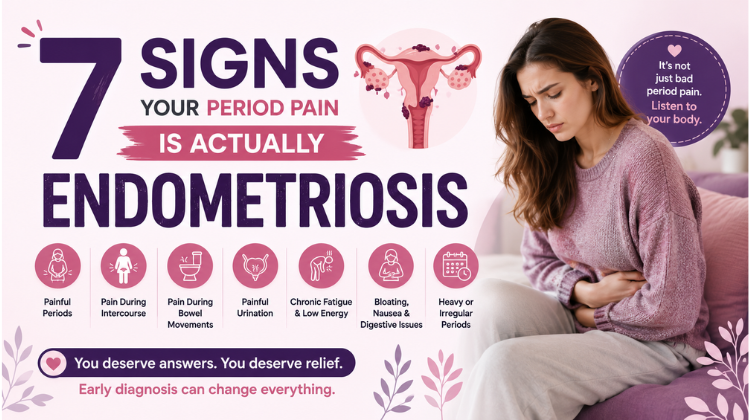
For generations, women have been told that severe abdominal cramping, backaches, and monthly fatigue are just normal parts of a menstrual cycle. However, dismissing severe pelvic discomfort can delay critical medical intervention. If you are constantly missing school, work, or social events because of debilitating cramps, it is time to recognize that your Period Pain is Actually Endometriosis.
Endometriosis is a chronic, often progressive condition where tissue similar to the lining of the uterus grows outside the uterine cavity. This misplaced tissue behaves just like endometrial tissue—it thickens, breaks down, and bleeds with each menstrual cycle, but has no way to exit the body. This leads to internal inflammation, scarring, and severe pain. Let’s explore the seven warning signs that indicate your Period Pain is Actually Endometriosis, helping you understand when to seek specialized care.
1. Traditional Painkillers Offer Zero Relief
Normal menstrual cramps are driven by prostaglandins and typically respond well to over-the-counter anti-inflammatory medications. If your monthly Period Pain is Actually Endometriosis, standard painkillers will barely make a dent in your discomfort. When pelvic tissue becomes heavily scarred and inflamed, standard over-the-counter options fail, signaling an underlying systemic issue.
2. You Experience Pain Outside Your Menstrual Window
While ordinary menstrual discomfort centers around the first few days of bleeding, endometriosis pain refuses to stick to a tight schedule. If your Period Pain is Actually Endometriosis, you will frequently feel deep pelvic aching, lower back pain, or throbbing leg pain days before your period starts or weeks after it ends, often lingering through ovulation.
3. Deep Pain During or After Intimacy
Ordinary menstrual cramps do not typically cause severe discomfort during intercourse. However, when endometrial-like implants develop on the uterosacral ligaments or the rectovaginal septum, physical pressure triggers deep, sharp, or throbbing pelvic distress. Realizing this specific type of Period Pain is Actually Endometriosis can guide you to seek a specialized gynecological evaluation.
4. Distressed Bowel or Bladder Movements During Your Cycle
Because endometrial tissue can attach itself to the outer walls of the intestines, rectum, or bladder, cyclical hormone shifts directly irritate these organ systems.
> **Common Misdiagnosis:** Many women are misdiagnosed with Irritable Bowel Syndrome
 (IBS). If you experience severe painful bowel movements, diarrhea, constipation,
or painful urination specifically during your menstrual cycle, your underlying
**Period Pain is Actually Endometriosis**.
5. Menstrual Flow is Exceptionally Heavy and Prolonged
While light to moderate cramping is normal, bleeding through heavy pads or tampons every single hour is a distinct red flag. Women whose Period Pain is Actually Endometriosis frequently experience prolonged periods lasting more than seven days, accompanied by large, painful blood clots, pointing to severe hormonal and uterine inflammation.
6. Unexplained Chronic Fatigue and Brain Fog
Endometriosis is more than a localized pelvic condition; it triggers an ongoing, full-body inflammatory response. The body exhausts massive amounts of cellular energy trying to process internal inflammation and localized bleeding. If your monthly Period Pain is Actually Endometriosis, your cycle will be accompanied by severe, systemic exhaustion, low immunity, and brain fog that sleep cannot cure.
7. Difficulty Conceiving or Ongoing Infertility
Many women discover that their Period Pain is Actually Endometriosis only after facing unexpected difficulties when trying to conceive. The inflammatory environment created by the condition can damage eggs, distort pelvic anatomy, or create physical blockages in the fallopian tubes, making an early and accurate diagnosis essential for safeguarding your reproductive health.
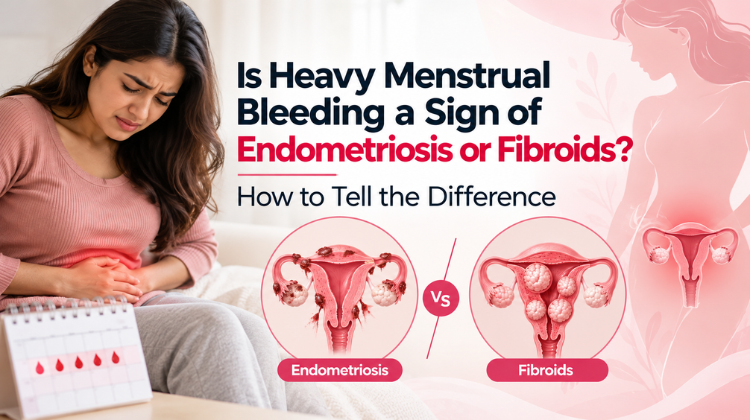
Menstrual Cramps vs. Endometriosis Symptoms
| Normal Period Pain | Endometriosis Pain |
| Lasts 1–3 days during bleeding | Occurs throughout the month |
| Relieved by standard painkillers | Unresponsive to basic NSAIDs |
| No pain during intercourse | Deep pain during intimacy |
| Normal bowel and bladder function | Cyclical IBS-like symptoms |
Molecular Mechanics: Cellular Pathophysiology and Inflammation Cascades
Endometriosis is an estrogen-dependent, systemic inflammatory disease characterized by the implantation and growth of endometrial-like tissue outside the uterine cavity. While retrograde menstruation (Sampson’s theory) occurs in up to $90\%$ of women, only a fraction develop ectopic lesions. This indicates that intrinsic cellular anomalies and immune clearance deficits play a vital role in disease progression.
┌─────────────────────────────────────────────────────────────────────────────┐
│                 Ectopic Endometriotic Lesion Cascade                        │
├─────────────────────────────────────────────────────────────────────────────┤
│ Retrograde Menstruation / Coelomic Metaplasia                               │
│                                │                                            │
│                                ▼                                            │
│ Defective Immune Surveillance (Impaired NK & Macrophage Clearance)          │
│                                │                                            │
│                                ▼                                            │
│ Ectopic Epithelial Attachment & Extracellular Matrix Degradation            │
│                                │                                            │
│                                ▼                                            │
│ Pro-Inflammatory Cytokine Storm (IL-1β, IL-6, TNF-α, COX-2)                  │
│                                │                                            │
│                                ▼                                            │
│ Localized Hyperestrogenism & Progesterone Resistance                        │
│                                │                                            │
│                                ▼                                            │
│ Neovascularization, Neurogenesis, Fibrosis & Adhesion Formation             │
└─────────────────────────────────────────────────────────────────────────────┘
Localized Hyperestrogenism and Progesterone Resistance
Ectopic endometriotic implants create their own microendocrine environment. Unlike normal endometrium, ectopic tissue aberrantly expresses aromatase and 17$\beta$-hydroxysteroid dehydrogenase type 1, enzymes that convert systemic precursors directly into active 17$\beta$-estradiol.
Simultaneously, the lesions exhibit marked progesterone resistance caused by an abnormally low ratio of Progesterone Receptor B (PR-B) to PR-A. This loss of progesterone signaling prevents the suppression of estrogen-driven cellular proliferation and downregulates $17\beta$-hydroxysteroid dehydrogenase type 2 (the enzyme responsible for inactivating estradiol into estrone), locking the ectopic tissue in a self-sustaining cycle of continuous growth and chronic inflammation.
Cytokine Storm and Prostaglandin Amplification
Estrogen-stimulated lesions recruit peritoneal macrophages that secrete elevated concentrations of pro-inflammatory cytokines, including Interleukin-1$\beta$ (IL-1$\beta$), IL-6, and Tumor Necrosis Factor-$\alpha$ (TNF-$\alpha$).
These cytokines activate Cyclooxygenase-2 (COX-2) within both ectopic stromal cells and surrounding peritoneal mesothelium. COX-2 catalyzes the hyper-synthesis of Prostaglandin $\text{E}_2$ ($\text{PGE}_2$) and $\text{PGF}_{2\alpha}$, driving intense uterine muscle hyper-contractility, sensitizing local pain receptors, and promoting further aromatase expression.
Neurovascular Priming: Peripheral Sensitization and Central Sensitization
The pain associated with endometriosis extends beyond simple mechanical pressure. Over time, chronic tissue inflammation transforms nociceptive signals into a complex neuropathic pain condition.
                 [Nociceptive Signaling Architecture]
                                   │
     ┌─────────────────────────────┴─────────────────────────────┐
     ▼                                                           ▼
[Peripheral Neuro-Angiogenesis]                 [Central Sensitization Loop]
- VEGF-driven capillary sprouting               - Spinal cord dorsal horn hyperexcitability
- Nerve Growth Factor (NGF) secretion           - Brain microglial cell activation
- Dense unmyelinated C-fiber infiltration       - Lowered pain thresholds (Allodynia)
Peripheral Neuro-Angiogenesis
Endometriotic lesions secrete Vascular Endothelial Growth Factor (VEGF) and Nerve Growth Factor (NGF), stimulating synchronized vessel sprouting and sensory nerve ending growth. Newly formed, unmyelinated C-fibers infiltrate the fibrotic stroma surrounding ectopic implants. These sensory fibers continuously fire in response to local acidic $\text{pH}$ shifts and cytokine bursts, resulting in severe local pelvic pain.
Central Sensitization and Pelvic Cross-Organ Sensitization
Continuous sensory input from pelvic nerve branches alters central nervous system processing:
-
Spinal Hyperexcitability: Dorsal horn neurons in the spinal cord undergo functional changes, becoming overly sensitive to sensory inputs.
-
Allodynia and Hyperalgesia: Non-painful stimuli (such as bowel transit, bladder filling, or soft touch) trigger sharp pain signals.
-
Cross-Talk Effects: Shared neural pathways between pelvic organs can trigger secondary painful conditions, such as Irritable Bowel Syndrome (IBS), Painful Bladder Syndrome (Interstitial Cystitis), and pelvic floor myofascial spasms.
Phenotypic Spectrum and Revised ASRM vs. ENZIAN Staging
Endometriosis presents across distinct anatomical phenotypes, each requiring tailored clinical and surgical approaches.
┌─────────────────────────────────────────────────────────────────────────────┐
│                    Endometriosis Anatomical Phenotypes                      │
├─────────────────────────────────────────────────────────────────────────────┤
│ 1. Superficial Peritoneal Endometriosis (SPE)                              │
│    • Translucent, red, or dark "powder-burn" implants on pelvic peritoneum  │
│                                                                             │
│ 2. Ovarian Endometriomas (OMA)                                              │
│    • Pseudocysts lined with invaginated cortex containing thick dark blood   │
│                                                                             │
│ 3. Deep Infiltrating Endometriosis (DIE)                                    │
│    • Solid nodular masses penetrating $>5\text{ mm}$ below peritoneal surface│
│      affecting uterosacral ligaments, rectovaginal septum, bowel, bladder   │
└─────────────────────────────────────────────────────────────────────────────┘
| Staging System | Core Evaluation Focus | Clinical & Surgical Limitations |
| rASRM (Revised American Society for Reproductive Medicine) | Quantifies superficial vs. deep lesions, adhesions, and ovarian cyst volume into Stages I–IV | Correlates poorly with clinical pain severity or deep infiltrating organ involvement |
| #Enzian Classification | Maps Deep Infiltrating Endometriosis across Compartment A (vagina/rectovaginal septum), B (uterosacral ligaments/pelvic side wall), and C (rectum/sigmoid bowel) | Provides precise pre-surgical planning maps via high-resolution ultrasound/MRI |
                              [#Enzian Anatomical Mapping]
                                           │
     ┌─────────────────────────────────────┼─────────────────────────────────────┐
     ▼                                     ▼                                     ▼
[Compartment A]                       [Compartment B]                       [Compartment C]
- Midline structures                  - Lateral structures                  - Intestinal structures
- Vagina & rectovaginal septum        - Uterosacral ligaments & ureters     - Rectum & sigmoid colon
Advanced Non-Invasive Diagnostic Protocols
The historical 7-to-10-year diagnostic delay for endometriosis is being reduced through advanced, non-invasive imaging techniques that allow accurate pre-operative mapping without relying entirely on exploratory diagnostic laparoscopy.
┌─────────────────────────────────────────────────────────────────────────────┐
│                   Diagnostic Diagnostic Workflow                            │
├─────────────────────────────────────────────────────────────────────────────┤
│ 1. Deep Infiltrating Endometriosis Transvaginal Ultrasonography (DIE-TVUS)  │
│    • Systematic 4-step dynamic mapping technique                            │
│    • Evaluation of "sliding sign" between anterior rectum and posterior uterus│
│                                                                             │
│ 2. Dedicated Pelvic High-Field Magnetic Resonance Imaging (MRI)             │
│    • T1-weighted hyperintensity scans for micro-hemorrhages and endometriomas │
│    • T2-weighted hypointense nodular mapping for fibrotic DIE masses        │
│                                                                             │
│ 3. Saline/Gel Sonovaginography & Sonoclyster                              │
│    • Delineates subtle vaginal mucosal and rectovaginal septal involvement   │
└─────────────────────────────────────────────────────────────────────────────┘
The Dynamic “Sliding Sign” Ultrasound Technique
During a specialized transvaginal scan, the clinician applies gentle pressure with the probe against the cervix while using an abdominal hand to assess how freely the rectum slides past the posterior uterine wall. A negative sliding sign indicates adhesions that obscure the pouch of Douglas, pointing to deep infiltrating disease.
Comprehensive Multimodal Therapeutics: Medical, Surgical, and Lifestyle
Effective long-term control of endometriosis requires a combination of targeted medical management, precision surgery, and anti-inflammatory lifestyle support.
                           [Endometriosis Treatment Matrix]
                                          │
     ┌────────────────────────────────────┼────────────────────────────────────┐
     ▼                                    ▼                                    ▼
[Medical & Suppression]            [Surgical Precision]                [Multidisciplinary Support]
- Continuous progestins            - Complete laparoscopic excision    - Anti-inflammatory nutrition
- GnRH Receptor Antagonists        - Preservation of ovarian reserve   - Pelvic floor physical therapy
- LNG-IUS intrauterine release     - Nerve-sparing pelvic dissection   - Cognitive Pain Management
Pharmacological Management
-
Continuous Progestin Therapy: Second-generation progestins (such as Dienogest) downregulate estrogen receptors, inhibit systemic gonadotropin secretion, suppress COX-2, and induce atrophy of ectopic endometrial tissue.
-
Oral GnRH Antagonists: Medications like Elagolix or Relugolix block pituitary GnRH receptors in a dose-dependent manner, allowing precise titration of systemic estrogen levels to suppress pain while mitigating bone density loss.
Surgical Philosophy: Complete Laparoscopic Excision
Modern surgical protocols prioritize laparoscopic excision over simple ablation or fulguration. Ablation heats only the superficial tip of a lesion, often leaving underlying fibrotic tissue intact. Complete excision removes the entire implant along with its surrounding fibrotic margins, significantly reducing disease recurrence rates.
Fertility Preservation and Reproductive Optimization
Endometriosis can impair fertility through mechanical distortions, altered tubal motility, compromised oocyte quality, and reduced endometrial receptivity.
  [Pelvic Inflammation] ──> [Oxidative Stress in Follicular Fluid] ──> [Poor Oocyte Quality]
            │                                                                 │
            ▼                                                                 ▼
  [Adhesions & Tubal Distortion] <── [Fibrotic Scarring] <── [Impaired Embryo Implantation]
Mitigating Ovarian Reserve Loss During Endometrioma Surgery
Stripping an ovarian endometrioma wall can inadvertently remove healthy, adjacent primordial follicles. To safeguard reproductive potential:
-
Assess pre-operative Anti-Müllerian Hormone (AMH) levels and antral follicle counts.
-
Utilize precise surgical techniques—such as hydrodissection, bipolar micro-hemostasis, or plasma jet vaporisation—to destroy the inner cyst lining without burning normal ovarian tissue.
-
Consider pre-operative oocyte or embryo cryopreservation for patients with bilateral endometriomas or low baseline ovarian reserve prior to extensive pelvic surgery.
Specialized Care for Complex Endometriosis
Dr. Preeti Rastogi provides comprehensive care for advanced endometriotic disease:
-
Advanced Non-Invasive Mapping: Pre-operative evaluation using high-resolution ultrasound protocols to map deep infiltrating nodules across the bowel, bladder, and pelvic ligaments.
-
Robotic Precision Excision: Surgical management using the Da Vinci Xi system, enabling precise removal of deep lesions while preserving delicate pelvic nerves and organs.
-
Integrated Fertility Care: Fertility-sparing surgical approaches designed to preserve ovarian reserve and optimize chances for natural or assisted conception.
Her extensive clinical background, UK NHS hospital experience, and commitment to compassionate patient outcomes establish her as the best gynaecologist in gurugram.
About Dr. Preeti Rastogi
-
Current Position: Director and Head of the Department of Obstetrics and Gynaecology at Medanta – The Medicity, Gurgaon.
-
Experience Baseline: Over 30 years of premier clinical experience working across top-tier tertiary hospitals in India and the United Kingdom (including a decade at the University Hospital of Wales, Cardiff).
-
Core Specializations: Advanced urogynaecology, complex pelvic reconstructive surgery, minimal access laparoscopic endo-gynaecology, and high-risk obstetric care.
-
Robotic Surgery Expertise: Certified Da Vinci Xi Robotic Surgeon, utilizing advanced robotic precision to perform minimally invasive excisions of complex endometrial lesions.
-
Academic Fellowships: Earned her prestigious MRCOG from the Royal College of Obstetricians and Gynaecologists (UK) and a DNB in Obstetrics and Gynaecology from St. Stephen’s Hospital, Delhi.
Taking Control of Your Pelvic Health
If these warning signs resonate with your monthly experiences, remember that you do not have to suffer in silence. Recognizing that your Period Pain is Actually Endometriosis is the first step toward reclaiming your quality of life. Schedule an appointment with a dedicated specialist who can offer an accurate diagnosis and create a comprehensive, personalized care plan tailored to your needs.
#EndometriosisSymptoms2026 #SevereMenstrualCramps #ChronicPelvicPain #DysmenorrheaSigns #HeavyPeriodsTreatment #PainfulIntercourseCure #PelvicInflammation #DrPreetiRastogiGynecologist #MedantaHospitalGurgaon #BestGynaeGurgaon #LaparoscopicExcisionSurgery #DaVinciXiRoboticGynae #InfertilityCausesWomen #OvarianCystsDiagnosis #ChocolateCystTreatment #DyscheziaSymptoms #HormonalImbalanceRemedies #WomenHealthAdvocate #RetrogradeMenstruation #PelvicMRIScan #AbdominalBloatingCycle #AntiInflammatoryDietPeriod #EndoWarriorIndia #ReproductiveHealth2026 #UterineFibroidsSymptoms #AdenomyosisvsEndometriosis #IrritableBowelSyndromePeriod #MinimallyInvasiveGynae #GynaecologyExpertsGurugram #HighRiskObstetricsDoctor #RoyalCollegeGynaeUK
FAQ
Q1: How do I know if my severe Period Pain is Actually Endometriosis?
A: If your Period Pain is Actually Endometriosis, your cramps will typically be unresponsive to standard over-the-counter painkillers. The pain will often spread to your lower back and legs, occur outside your period days, and be accompanied by heavy bleeding, painful intercourse, or cyclical bowel issues like bloating and constipation.
Q2: What diagnostic tests confirm that my Period Pain is Actually Endometriosis?
A: While a clinical evaluation and specialized imaging (like a high-resolution pelvic ultrasound or pelvic MRI) can indicate the presence of deep infiltrating lesions or chocolate cysts, the gold standard for confirming that your Period Pain is Actually Endometriosis remains a minimally invasive diagnostic laparoscopy.
Q3: Why is Dr. Preeti Rastogi considered the best gynecologist in Gurgaon for endometriosis treatment?
A: Dr. Preeti Rastogi is recognized as the best gynecologist in Gurgaon due to her 30+ years of global clinical expertise across India and the UK. As the Director of Obstetrics and Gynaecology at Medanta – The Medicity, she specializes in advanced laparoscopy and robotic surgery, providing precise, evidence-based management for complex gynecological conditions.
Q4: How does Dr. Preeti Rastogi treat patients whose Period Pain is Actually Endometriosis at Medanta?
A: Dr. Preeti Rastogi takes a holistic, multidisciplinary approach to endometriosis care. Depending on the disease stage and the patient’s fertility goals, she offers customized treatment plans that combine advanced hormonal management with precise laparoscopic or robotic excision surgery to remove abnormal tissue while preserving reproductive health.
Q5: Can lifestyle modifications help if my Period Pain is Actually Endometriosis?
A: Yes, lifestyle changes can support your medical treatment plan. Adopting a nutrient-dense anti-inflammatory diet, managing daily stress levels, engaging in low-impact pelvic floor exercises, and maintaining regular medical monitoring with a specialist can help reduce overall inflammation and ease pelvic discomfort.