Comparing the Benefits: Laparoscopic Ovarian Cystectomy vs. Traditional Open Surgery
Managing your reproductive health often comes with tough decisions, especially when diagnosed with an ovarian cyst that requires surgical intervention. The primary choice usually boils down to Laparoscopic Ovarian Cystectomy vs. Traditional Open Surgery. While both procedures aim to remove the cyst and preserve ovarian function, they differ significantly in technique, recovery time, and long-term outcomes.
In this guide, we will break down the key differences to help you understand why many women and surgeons today prefer the minimally invasive approach.
What is Laparoscopic Ovarian Cystectomy?
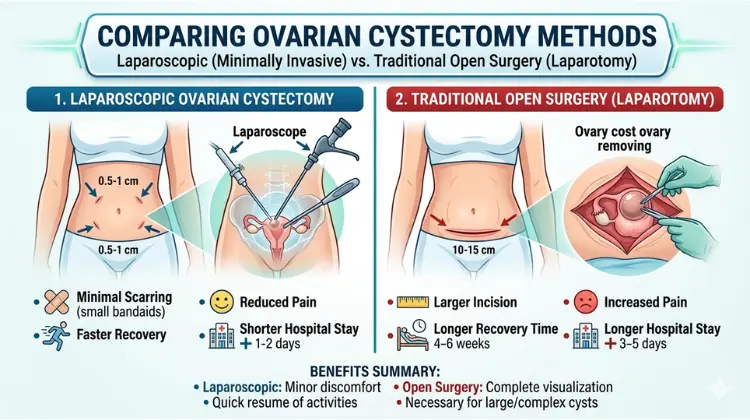
A Laparoscopic Ovarian Cystectomy is a modern, minimally invasive procedure. Instead of one large incision, a surgeon makes 3–4 tiny incisions (usually 0.5 to 1 cm) in the abdomen. A laparoscope—a thin tube with a high-definition camera—is inserted, allowing the surgeon to view the pelvic organs on a monitor and remove the cyst with precision tools.
Key Advantages of the Laparoscopic Approach
-
Minimal Scarring: Because the incisions are tiny, they often require only a single stitch or surgical glue.
-
Faster Recovery: Most patients return to their normal routine within 1 to 2 weeks.
-
Reduced Pain: Less tissue trauma means significantly lower post-operative discomfort.
-
Shorter Hospital Stay: Many patients go home the same day or within 24 hours.
What is Traditional Open Surgery (Laparotomy)?
Traditional Open Surgery, also known as a laparotomy, involves a single large incision (typically 10–15 cm) across the lower abdomen. This method provides the surgeon with direct physical access and a wide field of view.
While laparoscopy is the gold standard for benign cysts, Laparoscopic Ovarian Cystectomy vs. Traditional Open Surgery comparisons often highlight that open surgery is still necessary for:
-
Extremely large cysts (typically over 10–15 cm).
-
Cases where there is a high suspicion of malignancy (cancer).
-
Complex internal adhesions from previous surgeries.
Comparing the Benefits: Laparoscopic Ovarian Cystectomy vs. Traditional Open Surgery
When evaluating Laparoscopic Ovarian Cystectomy vs. Traditional Open Surgery, it is essential to look at the clinical outcomes and the impact on your lifestyle.
1. Surgical Precision and Fertility
Laparoscopic surgery uses magnification, which helps surgeons peel the cyst wall away from healthy ovarian tissue more precisely. This is crucial for women of reproductive age who wish to preserve their fertility. In contrast, Laparoscopic Ovarian Cystectomy vs. Traditional Open Surgery studies suggest that open surgery may carry a slightly higher risk of forming internal adhesions (scar tissue) that can affect the fallopian tubes.
2. Infection and Complication Rates
Smaller incisions mean less exposure of internal organs to the air, which reduces the risk of post-operative infections. In the debate of Laparoscopic Ovarian Cystectomy vs. Traditional Open Surgery, laparoscopy consistently shows lower rates of blood loss and wound-related complications.
3. Recovery Timeline
-
Laparoscopic: Recovery takes 7–14 days.
-
Traditional Open: Recovery takes 4–6 weeks.
The choice between Laparoscopic Ovarian Cystectomy vs. Traditional Open Surgery often hinges on how quickly a patient needs to return to work or care for their family.
Also Read: Recovery Timeline: Returning to Work After Laparoscopic Ovarian Cystectomy in Gurgaon
The Surgical Paradigm Shift in Ovarian Cyst Management
For decades, traditional open abdominal surgery (laparotomy) was the standard approach for removing persistent, large, or symptomatic ovarian cysts. However, advancements in high-definition optics, micro-surgical tools, and energy devices have established laparoscopic ovarian cystectomy as the modern gold standard for benign ovarian masses.
                                  [ SURGICAL APPROACH SELECTION TRIAD ]
                                                    |
         +------------------------------------------+------------------------------------------+
         |                                                                                     |
 [ Tissue Trauma & Incision Scale ]                                         [ Intraoperative Visualization & Precision ]
         |                                                                                     |
  - Laparoscopy: 3–4 micro-ports (5–10mm)                                     - Laparoscopy: 10x magnified 3D/HD visual field
  - Open Surgery: 8–15cm bikini/vertical cut                                  - Open Surgery: Direct line-of-sight human vision
                                                    |
                                                    v
                                 [ Postoperative Healing & Adhesion Profile ]
                                 - Laparoscopy: Minimal tissue drying & scarring
                                 - Open Surgery: Higher pelvic adhesion risk
Understanding the core mechanical, physiological, and clinical differences between keyhole surgery and open laparotomy allows patients to make informed decisions alongside their gynaecologist in Gurgaon.
Head-to-Head Comparative Framework: Laparoscopy vs. Open Laparotomy
When evaluating both surgical approaches, looking at key operational and recovery metrics reveals clear advantages for patient outcomes:
+----------------------------------------------------------------------------------------------------+
|                                 SURGICAL COMPARISON MATRIX                                         |
+---------------------------------+----------------------------------+-------------------------------+
| Clinical / Recovery Parameter   | Laparoscopic Ovarian Cystectomy  | Traditional Open Surgery      |
|                                 | (Keyhole Approach)               | (Laparotomy)                  |
+---------------------------------+----------------------------------+-------------------------------+
| Incision Dimensions & Number    | 3 to 4 tiny micro-ports          | 1 single large incision       |
|                                 | (5mm to 10mm each)               | (8cm to 15cm horizontally)    |
+---------------------------------+----------------------------------+-------------------------------+
| Average Hospital Stay           | 24 hours (Daycare / 1-day stay)  | 3 to 5 inpatient days         |
+---------------------------------+----------------------------------+-------------------------------+
| Postoperative Pain Profile      | Mild to moderate (managed with   | Moderate to severe (requires  |
|                                 | oral analgesics)                 | IV narcotics / PCA pump)      |
+---------------------------------+----------------------------------+-------------------------------+
| Return to Normal Daily Work     | 7 to 10 days                     | 4 to 6 weeks                  |
+---------------------------------+----------------------------------+-------------------------------+
| Intraoperative Blood Loss       | Minimal (<30–50 mL)              | Moderate (150–300 mL)         |
+---------------------------------+----------------------------------+-------------------------------+
| Risk of Pelvic Adhesions        | Significantly lower              | Higher due to open exposure   |
+---------------------------------+----------------------------------+-------------------------------+
1. Incision Size, Tissue Trauma, and Cosmetic Outcomes
Traditional open laparotomy requires a large incision across the lower abdomen (Pfannenstiel “bikini cut” or vertical mid-line cut), cutting through abdominal skin, muscle sheaths, and fascial layers. In contrast, laparoscopic ovarian cystectomy in Gurgaon relies on three to four keyhole incisions measuring less than a centimeter. Micro-incisions heal with minimal cosmetic scarring, reducing wound complications like breakdown or incisional hernia.
2. Intraoperative Precision and Magnification
Using a high-definition laparoscope gives the surgeon up to 10x optical magnification of the pelvic organs. This clear visualization allows a minimally invasive gynaecology surgeon to identify delicate cleavage planes between the pathological cyst wall and healthy ovarian cortex, ensuring maximum ovarian reserve protection during cyst enucleation.
Clinical Decision-Making: When Is Open Surgery Still Indicated?
While keyhole surgery is preferred for most benign cysts, certain complex clinical scenarios still require traditional open laparotomy.
[ Initial Ultrasound / MRI Imaging + Tumor Markers (CA-125, HE4) ]
                                |
        +-----------------------+-----------------------+
        |                                               |
[ Benign Features / Size < 10–12 cm ]        [ Malignant Features / Giant Mass (>15 cm) ]
        |                                               |
        v                                               v
[ LAPAROSCOPIC CYSTECTOMY ]                 [ OPEN LAPAROTOMY / STAGING ]
  - Preservation of healthy tissue             - Intact specimen extraction without rupture
  - Rapid recovery & low pain                  - Comprehensive staging & lymph node sampling
Key Indications for Open Surgery:
-
High Suspicion of Malignancy: Cysts displaying solid components, thick septations, elevated cancer biomarkers (CA-125/HE4), or ascites are often managed via open laparotomy to allow intact specimen extraction without intra-abdominal spilling or rupture.
-
Giant Ovarian Cysts (>15 cm): Extremely large cysts occupying the entire pelvic and upper abdominal cavity can restrict the working space required for safe laparoscopic gas inflation (pneumoperitoneum).
-
Severe, Frozen Pelvic Adhesions: Patients with extensive prior open abdominal surgeries or severe Stage 4 endometriosis where bowel and vascular structures bind heavily to the pelvic wall may occasionally require open conversion for surgical safety.
Ovarian Tissue Preservation and Long-Term Fertility Impact
For women of reproductive age, preserving healthy ovarian cortex—and the primordial egg follicles within it—is a top surgical priority.
+----------------------------------------------------------------------------------------------------+
|                                    FERTILITY PRESERVATION PROTOCOLS                                |
+------------------------------------+---------------------------------------------------------------+
| Surgical Technique                 | Impact on Healthy Ovarian Cortex & Egg Supply                 |
+------------------------------------+---------------------------------------------------------------+
| Laparoscopic Cold Stripping &      | Peels the cyst capsule away gently along natural anatomical  |
| Hydro-Dissection                   | planes, saving healthy follicle-bearing tissue.             |
+------------------------------------+---------------------------------------------------------------+
| Precision Micro-Bipolar Energy     | Directs minimal thermal heat only to active bleeding points,  |
| Hemostasis                         | preventing thermal injury to surrounding follicles.          |
+------------------------------------+---------------------------------------------------------------+
| Blunt Traction / Gross Excision    | Risks tearing adjacent healthy tissue or over-cauterizing the  |
| (Outdated Open Methods)            | ovarian bed, reducing Anti-Müllerian Hormone (AMH) levels.   |
+------------------------------------+---------------------------------------------------------------+
Working with an expert recognized as the best gynaecologist in Gurgaon for cyst removal ensures that fertility-sparing techniques—such as hydro-dissection and micro-bipolar hemostasis—are used during keyhole procedures to protect long-term egg reserve.
Recovery Timelines: What to Expect Post-Procedure
The choice of surgical technique directly shapes the length and comfort of your recovery period.
Phase 1: Immediate Post-Op (Days 1 - 3)
  --> Laparoscopy: Discharged within 24 hours; walking comfortably.
  --> Open Surgery: Inpatient stay with IV pain relief and urinary catheter.

Phase 2: Early Recovery (Weeks 1 - 2)
  --> Laparoscopy: Return to light desk work and household activities.
  --> Open Surgery: Home rest; managing large abdominal wound discomfort.

Phase 3: Complete Healing (Weeks 3 - 6)
  --> Laparoscopy: Full clearance for driving, exercise, and normal work routines.
  --> Open Surgery: Gradual return to light activity; avoiding heavy lifting (>5 kg).
While ovarian cystectomy recovery time for keyhole surgery takes about 7 to 10 days, traditional open surgery requires 4 to 6 weeks of restricted activity to allow abdominal wall muscle and fascial layers to heal completely.
Financial Analysis: Ovarian Cyst Surgery Cost Comparison
When evaluating treatment options, looking at the overall financial commitment—including hospital stays, medications, and time off work—helps provide a complete picture.
+----------------------------------------------------------------------------------------------------+
|                         FINANCIAL PROFILE COMPARISON IN GURGAON                                    |
+---------------------------------+----------------------------------+-------------------------------+
| Expense Category                | Laparoscopic Cystectomy          | Open Laparotomy               |
+---------------------------------+----------------------------------+-------------------------------+
| Initial Hospital Package Fee    | Slightly higher due to specialized| Lower initial surgical equipment|
|                                 | video towers and energy tools    | instrument costs              |
+---------------------------------+----------------------------------+-------------------------------+
| Inpatient Room Charges          | Minimal (1 day / daycare stay)   | Higher (3 to 5 days room stay)|
+---------------------------------+----------------------------------+-------------------------------+
| Postoperative Medication Costs  | Lower (short painkiller course)  | Higher (extended antibiotics  |
|                                 |                                  | and injectable analgesics)    |
+---------------------------------+----------------------------------+-------------------------------+
| Total Indirect Cost (Work Loss) | Significantly lower (1 week off) | Higher (4–6 weeks off work)   |
+---------------------------------+----------------------------------+-------------------------------+
When considering the reduced hospital stay, fewer postoperative medications, and a much faster return to work, the total overall cost of keyhole surgery is comparable to open surgery. Most insurance providers cover medically indicated laparoscopic procedures; reviewing coverage details with your hospital’s billing desk clarifies out-of-pocket expenses.
Consult with Dr. Preeti Rastogi for Advanced Minimally Invasive Care
Choosing an experienced surgeon is key to achieving minimal scarring, a smooth recovery, and effective fertility preservation during cyst removal.
With over 25 years of international clinical experience across leading institutions in the UK and India, Dr. Preeti Rastogi—Director and Head of Department of Obstetrics and Gynaecology at Medanta Hospital, Gurgaon—is a recognized expert in minimally invasive laparoscopic and robotic gynaecological surgery.
Schedule a consultation today to evaluate your diagnosis and choose the safest surgical path for your health.
Making the Right Choice
While the benefits of the minimally invasive route are clear, the “best” surgery is the one that is safest for your specific condition. During your consultation, your gynecologist will review your ultrasound or MRI results to decide if Laparoscopic Ovarian Cystectomy vs. Traditional Open Surgery is the right path for you.
For patients in urban hubs like Gurgaon, accessing advanced robotic or laparoscopic facilities is easier than ever. Choosing an experienced surgeon who specializes in these techniques ensures that the debate of Laparoscopic Ovarian Cystectomy vs. Traditional Open Surgery ends with the best possible health outcome for you.
The Expertise of Dr. Preeti Rastogi
With over 30 years of experience spanning India and the United Kingdom, Dr. Preeti Rastogi is a veteran in gynecological care and is widely recognized as the best gynecologist in Gurgaon for complex surgical interventions. Currently serving as the Director and HOD of Obstetrics and Gynaecology at Medanta – The Medicity, Gurgaon, she is among the elite group of surgeons in India certified to operate the Da Vinci Xi Robotic System, ensuring that the choice between Laparoscopic Ovarian Cystectomy vs. Traditional Open Surgery always results in the most advanced care possible. Her prestigious qualifications include an MRCOG from the Royal College of Obstetricians and Gynaecologists, London, and a specialized Fellowship in Urogynaecology from the UK, underscoring her commitment to global medical standards.
#OvarianCystRemoval #MinimallyInvasiveSurgery #LaparotomyVsLaparoscopy #GynecologicalSurgery #RecoveryAfterCystectomy #OvarianCystSymptoms #FertilityPreservation #PCOS #EndometriosisSurgery #GurgaonGynecologist #WomenHealth #SurgicalRecovery #LaparoscopicSurgeon #PelvicPain #CystectomyRisks #OvarianCystTreatment #BenignOvarianCyst #RoboticCystectomy #PostOpCare #HealthTips #GynecologyGurgaon #InfertilityTreatment #SmallIncisionSurgery #MedicalComparison #PainManagement #KeyholeSurgery #AbdominalSurgery #OvarianHealth #ExpertGynecologist #SurgicalSafety
Understanding the Surgical Differences
When evaluating your options, understanding the nuances of a laparotomy for ovarian cyst versus modern minimally invasive gynaecology is crucial for long-term health. The post-operative recovery varies significantly between the two; while traditional methods involve a large incision, laparoscopy focuses on reducing surgical scarring and pain. At the Medanta gynaecology department, patients often have access to robotic-assisted surgery, which is the gold standard for benign ovarian cyst removal. By adhering to global patient safety standards, surgeons ensure proper abdominal incision care and utilize laparoscopic precision to minimize trauma.
In complex cases involving gynaecological oncology, an infection risk comparison shows that smaller incisions significantly lower complications. Furthermore, the hospital stay duration is drastically reduced with “keyhole” techniques, which are also superior for pelvic adhesion prevention and ovarian tissue preservation. By leveraging advanced surgical technology, the debate of cystectomy vs oophorectomy is often resolved in favor of saving the organ. Minimizing blood loss in surgery helps patients suffering from chronic pelvic pain recover faster. Always seek an expert surgical consultation to determine which approach aligns with your specific medical needs.
Frequently Asked Questions
1. Is Laparoscopic Ovarian Cystectomy safer than Traditional Open Surgery?
Generally, yes. For benign cysts, laparoscopy is considered safer due to lower risks of infection, less blood loss, and fewer post-operative complications compared to open surgery. Comparing the Benefits: Laparoscopic Ovarian Cystectomy vs. Traditional Open Surgery
2. How long is the hospital stay for Laparoscopic Ovarian Cystectomy vs. Traditional Open Surgery?
Laparoscopic patients are often discharged within 24 hours. Traditional open surgery usually requires a hospital stay of 2 to 4 days for monitoring. Comparing the Benefits: Laparoscopic Ovarian Cystectomy vs. Traditional Open Surgery
3. Can large cysts be removed laparoscopically?
Yes, many skilled surgeons can remove cysts larger than 10cm using laparoscopy by “bagging” the cyst and draining it before removal. However, if cancer is suspected, open surgery is preferred. Comparing the Benefits: Laparoscopic Ovarian Cystectomy vs. Traditional Open Surgery
4. How do I find the best gynecologist in Gurgaon for laparoscopic surgery?
Look for a gynecologist in Gurgaon who has specialized fellowship training in “Minimally Invasive Gynecology” or “Laparoscopic Surgery.” Check hospital affiliations (like Max or Fortis) and read patient reviews regarding their success with complex cyst removals. Comparing the Benefits: Laparoscopic Ovarian Cystectomy vs. Traditional Open Surgery
5. What is the cost difference between Laparoscopic Ovarian Cystectomy vs. Traditional Open Surgery in Gurgaon?
Laparoscopic surgery may have a higher upfront cost due to specialized equipment, but it often proves more economical overall because of the shorter hospital stay and faster return to work. Comparing the Benefits: Laparoscopic Ovarian Cystectomy vs. Traditional Open Surgery
6. Is laparoscopic cystectomy safe for very large cysts?
Yes, in experienced hands. Advanced laparoscopic techniques allow skilled surgeons to drain cysts safely inside a sterile extraction bag (Endobag) before removing the cyst wall through keyhole incisions without spilling fluid into the abdomen. Comparing the Benefits: Laparoscopic Ovarian Cystectomy vs. Traditional Open Surgery
7. Can a laparoscopic cystectomy turn into an open surgery during the procedure?
In a small percentage of cases (<1–2%), a surgeon may convert from laparoscopy to open surgery if severe, unexpected scarring is encountered, or if the mass shows signs of malignancy that require open staging for safety. Comparing the Benefits: Laparoscopic Ovarian Cystectomy vs. Traditional Open Surgery
8. Why is there shoulder pain after laparoscopic surgery?
Residual carbon dioxide (CO2) gas used to inflate the abdomen during surgery can irritate the phrenic nerve near the diaphragm, causing referred pain up to the shoulder. This harmless side effect usually resolves within 24 to 48 hours with light walking and warm compresses. Comparing the Benefits: Laparoscopic Ovarian Cystectomy vs. Traditional Open Surgery
9. How soon after laparoscopic cystectomy can I exercise?
Light walking is encouraged immediately after surgery. Low-impact exercise (such as brisk walking) can usually be resumed after 2 weeks, while high-impact workouts, heavy weightlifting, and abdominal exercises should be avoided for 3 to 4 weeks. Comparing the Benefits: Laparoscopic Ovarian Cystectomy vs. Traditional Open Surgery